

HubSpot Tax Transparency on Quotes, Invoices, and Payments: Why Tax Was Charged or Not Charged
If you've ever stared at a HubSpot quote or invoice wondering "why is there no tax on this?" — or the opposite, "why did HubSpot suddenly add tax to this deal?" — you're not alone. Tax behavior in HubSpot depends on which tool generated the document, how your tax settings are configured, and whether your buyer's location and product tax categories are set up correctly.
This guide breaks down exactly how HubSpot calculates (or skips) tax across quotes, invoices, payment links, and subscriptions, and gives you a practical troubleshooting path so tax transparency stops being a mystery for your revenue team and your customers.
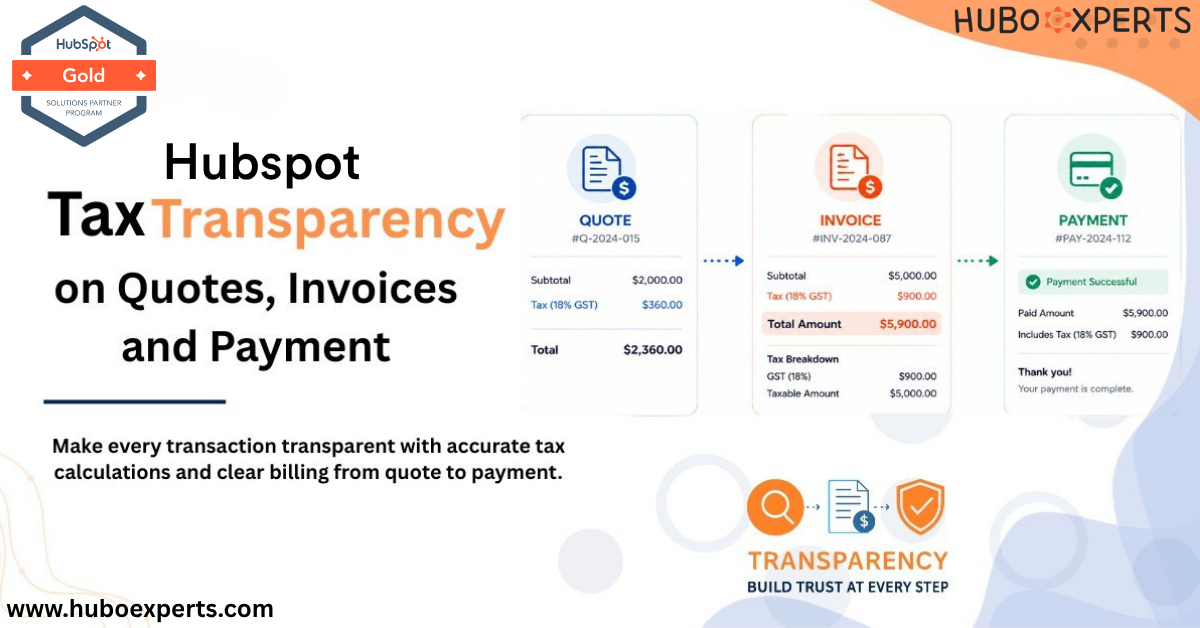
Why Tax Transparency Matters in Commerce Hub
Tax transparency isn't just a compliance checkbox — it directly affects deal velocity and customer trust. A buyer who sees a tax line item they don't understand may delay signing. A rep who sends a quote without tax, only for the invoice to include it later, creates a mismatch that damages credibility and can trigger renegotiation.
Getting tax visibility right on quotes, invoices, and payments means:
-
Buyers see the true total cost before they commit
-
Finance teams don't have to manually reconcile mismatched totals
-
Reps aren't fielding "why did this change?" emails after close
-
Your business stays aligned with tax obligations in the jurisdictions where you're registered
How HubSpot Handles Tax: Three Ways to Apply It
HubSpot supports three different methods for adding tax to a transaction: Automated Sales Tax, reusable rates from the Tax Library, and one-time manual taxes.
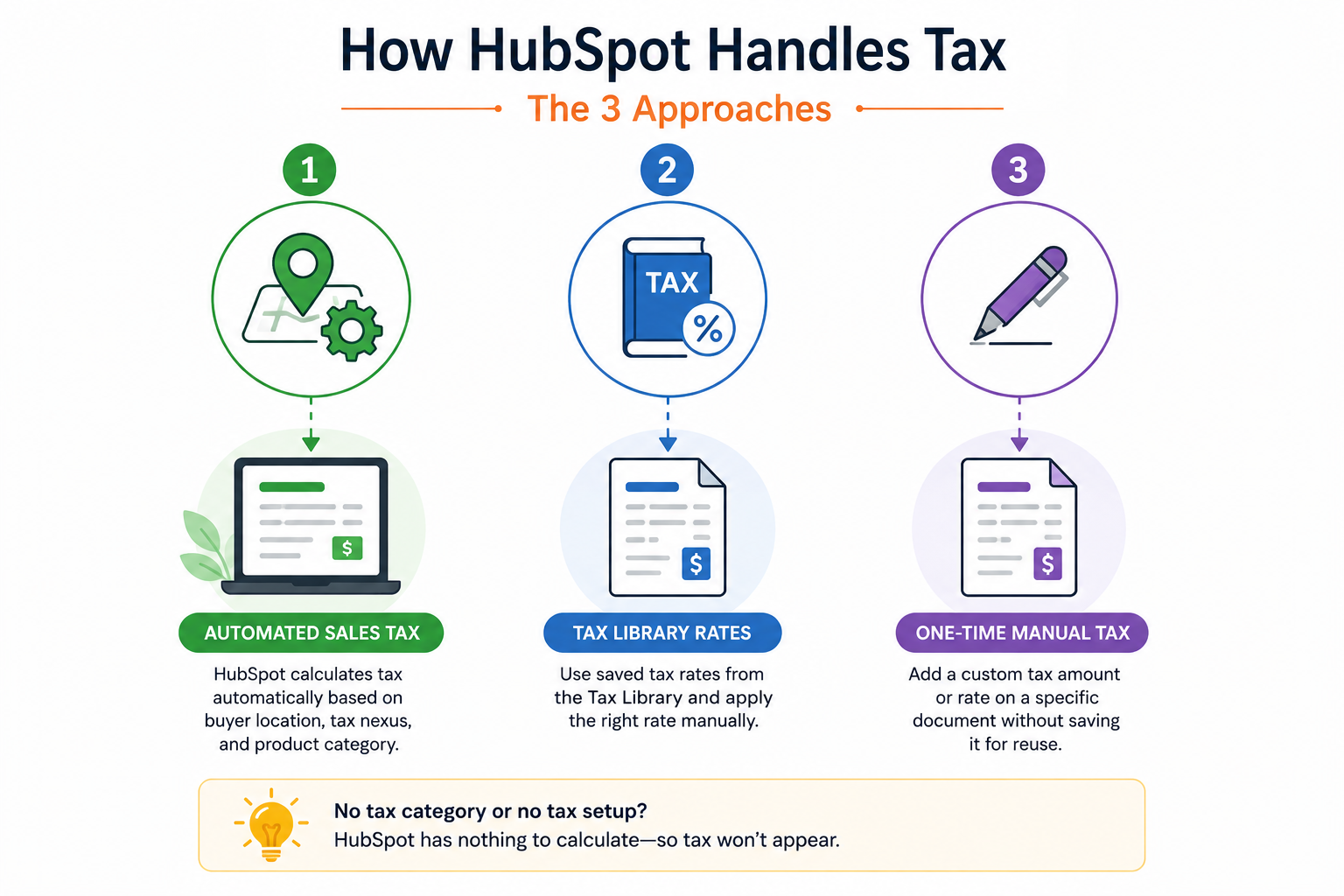
Automated Sales Tax calculates the applicable amount based on factors such as the buyer’s location, your tax registrations, and the tax category assigned to each product or service. This is the most dynamic option because the rate can change depending on the transaction details.
Tax Library rates are predefined percentages created inside HubSpot. A user selects and applies the appropriate rate to a line item or transaction. Unlike automated tax, HubSpot does not determine which saved rate should be used based on the buyer’s location.
One-time manual tax allows a user to add a tax directly to a specific transaction without saving it as a reusable rate. This is useful for occasional or exceptional cases but requires manual review each time.
Understanding which method your team uses is essential when troubleshooting missing or unexpected tax. Automated tax depends on complete buyer and product information, while library and one-time rates depend on a user applying the correct tax during document preparation.
Tax Calculation Flow: What Happens Behind the Scenes
When a line item is added to a quote, invoice, or payment link, HubSpot follows a series of checks before calculating tax.
First, HubSpot checks whether the product has a tax category assigned. Without a tax category, the system cannot determine the correct tax treatment, so no tax is calculated and the tax field remains blank.
Next, it checks whether Automated Sales Tax is enabled for the quote, invoice, or payment link. If automated tax is not enabled, HubSpot looks for a manually applied rate from the Tax Library instead.
If automated tax is enabled, the system then verifies whether the buyer’s address is available and located within a supported region. When the address is missing, tax calculation is deferred until the required address information is added.
HubSpot also checks whether the business has an active tax registration or nexus in the buyer’s jurisdiction. If the business is not registered to collect tax in that state, province, or region, no tax will be charged.
When all conditions are met, HubSpot calculates the applicable tax and displays it at both the line-item level and within the document total.
This process explains many common tax-related support issues. When tax appears to be missing or “disappears,” the cause is usually one of three things: the product does not have a tax category, the buyer’s address is incomplete, or the business is not registered to collect tax in that jurisdiction.
Top Reasons Tax Was NOT Charged
-
No tax category on the product — the single most common cause. Add a Tax Category to every product in Commerce > Products.
-
Automated Sales Tax isn't enabled — it must be turned on in Settings > Revenue/Payments > Tax, and it requires a qualifying Commerce Hub seat.
-
You're using standard quotes when your setup only supports legacy quotes — automated tax historically required legacy quotes; check which quote type your team is creating.
-
Buyer address is missing or incomplete — without a shipping/billing address, HubSpot can't determine the tax jurisdiction.
-
No tax registration (nexus) in the buyer's state, province, or country — HubSpot won't charge tax for a jurisdiction you haven't registered in.
-
The line item was manually marked or configured as non-taxable, or falls into a tax-exempt category (common for fees like credit card surcharges or parking, which many teams have to work around with a tax code mapping tool).
-
The object type doesn't yet support the tax method you expect — for example, subscription invoices have historically had gaps compared to one-time invoices.
-
API-created quotes or invoices — tax calculated through Automated Sales Tax has historically required the document to be finalized inside the HubSpot UI, not solely through the API.
-
Business is located outside the US, Canada, or UK without a supported Stripe-based configuration for Automated Sales Tax.
-
Currency or region mismatch between the buyer record and the deal/quote, which can prevent rate lookup.
Top Reasons Tax WAS Charged Unexpectedly
-
A tax category was recently added or bulk-updated on products, applying tax to quotes generated afterward
-
Automated Sales Tax was newly enabled account-wide, changing behavior on every open deal using those products
-
The buyer's address was corrected or completed, triggering a jurisdiction match that wasn't there before
-
A rep manually applied a Tax Library rate to a line item
-
A workflow action (e.g., a custom "Add Tax" automation) fired based on a deal property change
A Practical Troubleshooting Checklist
| Step | What to Check | Where |
|---|---|---|
| 1 | Product has a tax category assigned | Commerce > Products |
| 2 | Automated Sales Tax is turned on and set up correctly | Settings > Payments/Revenue > Tax |
| 3 | Buyer address is complete and accurate | Contact or Company record |
| 4 | Business has tax registration in that jurisdiction | Settings > Tax > Tax Registrations |
| 5 | Document type supports the tax method in use | Quote vs. legacy quote vs. invoice vs. subscription |
| 6 | No manual override or exemption applied at the line-item level | Line item detail on the quote/invoice |
| 7 | Document was finalized in the HubSpot UI (not left in a draft API state) | Quote/Invoice status |
Best Practices for Tax Transparency with Buyers
-
Show tax as a clearly labeled, separate line item — never bury it inside a bundled total
-
Keep product tax categories current, especially after adding new SKUs or services
-
Standardize on one quote type (avoid mixing standard and legacy quotes across the team) so tax behavior stays consistent
-
Document your tax registrations and review them quarterly as you expand into new states or countries
-
For complex multi-region or multi-rate needs (VAT-exempt line items, per-product exemptions), consider a dedicated tax engine integration such as Avalara AvaTax rather than relying solely on native rate fields
Ready to Fix Tax Gaps in Your HubSpot Portal?
Tax transparency issues rarely fix themselves — they compound as your product catalog and customer base grow across regions. If your quotes, invoices, or payment links are showing inconsistent tax behavior, Huboexperts can audit your Commerce Hub setup, map your tax categories correctly, and configure Automated Sales Tax or a third-party engine like AvaTax so every document is accurate the first time.
Frequently Asked Questions
1. Why doesn't my HubSpot quote show any tax?
The most common cause is a missing tax category on the product, or Automated Sales Tax not being enabled for your account. Check Commerce > Products first, then your Tax settings.
2. Does HubSpot calculate tax automatically, or do I have to set rates manually?
Both options exist. Automated Sales Tax calculates rates based on buyer location and product category in real time. Alternatively, you can build a Tax Library of fixed rates and apply them manually to line items.
3. Can I apply different tax rates to different line items on the same quote?
Yes, when using the Tax Library or line-item level tax categories with Automated Sales Tax — each line item can carry its own tax category or rate, though historically some teams have needed workarounds for full flexibility.
4. Why did tax appear on my invoice but not on the original quote?
This usually happens when the quote used a document type or tool that doesn't support automated tax calculation, but the invoice generated afterward does, or when the buyer's address was completed between the two steps.
5. Is Automated Sales Tax available outside the US and Canada?
It's primarily built for businesses based in the United States, Canada, and the United Kingdom, with Stripe-based configurations extending support to more countries where Stripe operates.
6. Do I need HubSpot Payments or Stripe to use Automated Sales Tax?
Not always. If your business is based in the US, UK, or Canada, you can set up Automated Sales Tax without enrolling in a payment processor first, though a processor is required for certain regions.
7. Why is a line item like a processing fee still getting taxed?
If the fee's product record doesn't have a "non-taxable" or exempt category set, HubSpot treats it like any other taxable item. Some teams use a third-party tax engine to manage exemptions like this more precisely.
8. Can tax be calculated on quotes or invoices created through the API?
Native Automated Sales Tax has historically required the document to be finalized inside the HubSpot UI rather than fully processed via API, though this is an area HubSpot has continued to develop.
9. Why does a subscription invoice not show a tax line the way a one-time invoice does?
Recurring line-item tax support on subscription invoices has rolled out later than support for one-time invoices, so older accounts or certain billing configurations may not display it yet.
10. What subscription level do I need for tax features in HubSpot?
Automated Sales Tax and the Tax Library are generally available on Commerce Hub (Revenue Hub) Professional or Enterprise plans, with at least one assigned seat required to activate automated calculation account-wide.

