

In today’s digital-first world, data isn’t just a byproduct of business — it’s the fuel that drives competitive advantage, innovation, and strategic decision-making. From customer experience and marketing performance to sales forecasting and operational efficiency, almost every modern business decision depends on the quality and accessibility of data.
But there’s a catch.
As businesses scale, data grows faster than teams can manage it. Multiple tools, disconnected systems, duplicated records, missing fields, inconsistent naming conventions, poor governance, and weak privacy practices can quietly turn data into a liability instead of an asset.
And in 2026, this gap is becoming impossible to ignore.
The organizations that win will not necessarily be the ones with the most data — they’ll be the ones with the best-managed data.
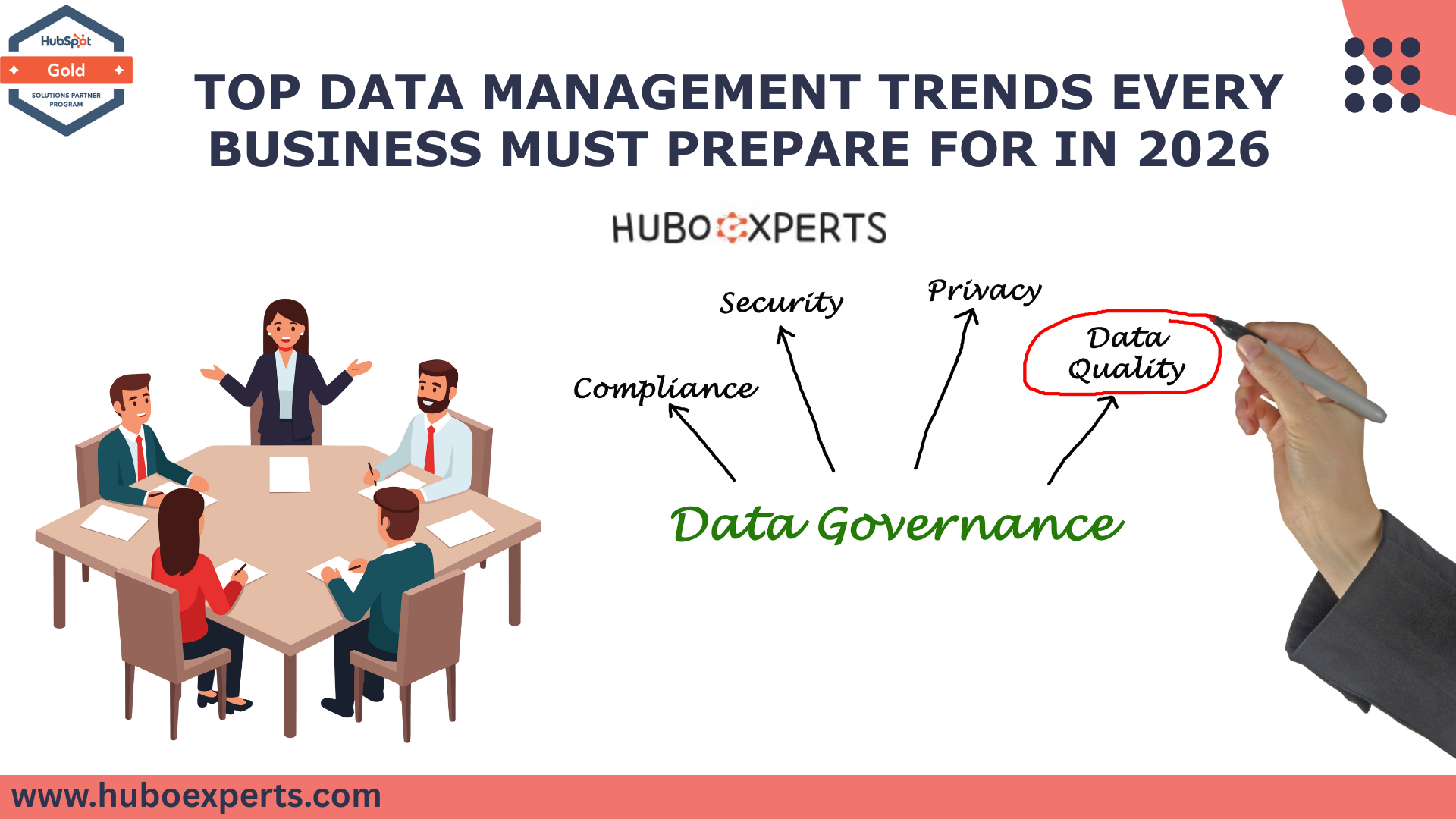
At HuboExpert, we work closely with growing companies, marketing teams, and revenue leaders who want clarity, control, and measurable ROI from their digital ecosystem. Based on what we’re seeing across industries, here are the top data management trends every business must prepare for in 2026 — not later, but now.
Let’s dive in.
1. AI-Driven Data Quality and Governance Will Become Non-Negotiable
For years, businesses have tried to manage data quality using manual processes:
-
Cleaning Excel sheets
-
Fixing CRM properties by hand
-
Deduplicating contacts manually
-
Auditing data once every quarter
-
Creating “rules” that nobody follows
The reality is simple: manual governance doesn’t scale.
In 2026, AI-driven data governance is moving from optional to essential, especially for businesses that rely on CRM, marketing automation, and multi-channel reporting.
What AI can do in data management now
AI-powered systems are increasingly capable of:
-
Detecting missing values and inconsistent formats automatically
-
Identifying duplicates across systems even when the names differ
-
Spotting anomalies (e.g., sudden spike in invalid emails, wrong country codes)
-
Suggesting corrections using historical patterns
-
Predicting missing information using enrichment models
-
Enforcing governance rules across multiple tools
Instead of waiting for the problem to become visible in reports, AI catches it at the source.
Why it matters for business leaders
Bad data doesn’t just create messy dashboards. It creates real business damage:
-
Sales teams chase the wrong leads
-
Marketing attribution becomes unreliable
-
Customer experience breaks (wrong names, wrong personalization)
-
Reporting becomes political instead of factual
-
Teams stop trusting dashboards
When trust breaks, adoption breaks.
HuboExpert Insight
AI governance tools don’t replace humans — they amplify your team’s accuracy and speed. The smartest businesses in 2026 will start small with pilot use cases:
-
Lead data validation
-
Contact deduplication rules
-
Enrichment workflows
-
Deal pipeline hygiene checks
And then scale to enterprise-wide governance.
2. Data Mesh and Data Fabric Architectures Will Replace Centralized Thinking
For a long time, companies believed the best way to manage data was centralization:
“One data warehouse, one BI team, one source of truth.”
That worked when data volume was smaller and business teams moved slower.
But in 2026, business teams demand:
-
Faster access to insights
-
Real-time reporting
-
Self-service dashboards
-
Cross-platform visibility
-
Ownership and accountability
This is where Data Mesh and Data Fabric come in.
What is Data Fabric?
A Data Fabric is a connected data architecture that uses automation, integration layers, and metadata to unify data across:
-
Cloud environments
-
CRMs and ERPs
-
Marketing platforms
-
Customer support tools
-
Data warehouses and lakes
It reduces friction between systems and makes data more discoverable.
What is Data Mesh?
A Data Mesh decentralizes ownership. Instead of one central team owning all data, each domain team owns its own “data product,” for example:
-
Sales owns pipeline and forecasting data
-
Marketing owns campaign and attribution data
-
Finance owns billing and revenue data
-
Support owns customer health data
Why this shift is happening
Centralized models create bottlenecks:
-
Business teams wait weeks for reports
-
Data teams become overloaded
-
Ownership becomes unclear
-
Quality drops as systems scale
Mesh and Fabric models help organizations scale data access without breaking governance.
HuboExpert Tip
Start with your most business-critical domains first:
-
Marketing performance and ROI
-
Sales pipeline and forecasting
-
Customer retention metrics
Then build governance rules from Day 1, otherwise decentralization becomes chaos.
3. Privacy-First Data Management Will Become a Competitive Advantage
Privacy isn’t just a legal checkbox anymore.
In 2026, privacy is becoming a brand trust factor.
Customers are more aware of how their data is collected and used. Governments are enforcing stricter compliance. And even B2B buyers are asking deeper questions about security and consent.
What privacy-first data management looks like
Privacy-first means building systems that support:
-
Data minimization (collect only what you need)
-
Classification (PII vs non-PII data)
-
Consent tracking across channels
-
Encryption in storage and transit
-
Role-based access controls
-
Audit logs and monitoring
-
Policy enforcement automatically
Why businesses must act now
Privacy risks are expensive:
-
Legal penalties
-
Brand damage
-
Loss of customer trust
-
Disrupted marketing campaigns
-
Data leaks that lead to churn
The biggest mistake businesses make is treating privacy as an afterthought.
HuboExpert Insight
Privacy-conscious businesses don’t just avoid fines — they win loyalty in an era of data skepticism.
Companies that communicate privacy clearly, respect consent, and protect customer data will be trusted more — and in 2026, trust converts better than discounts.
4. Real-Time and Streaming Analytics Will Redefine Decision-Making
Old reporting models were built around delays:
-
Daily reports
-
Weekly dashboards
-
Monthly performance reviews
But today’s market doesn’t wait.
In 2026, competitive advantage is shifting toward businesses that can respond instantly.
What real-time analytics enables
Streaming data helps businesses:
-
Trigger instant personalization (email, SMS, ads, WhatsApp)
-
Detect risk early (fraud, churn signals, support escalation)
-
Improve operations (inventory, delivery tracking, lead response time)
-
Adjust campaigns mid-flight instead of after the budget is spent
Why it matters for marketing and sales
Marketing teams want to know:
-
Which ads are driving qualified leads right now
-
Which campaign is generating pipeline today
-
Which landing page is converting this hour
Sales teams want:
-
Alerts when a high-intent lead revisits pricing
-
Notifications when a contact opens proposals
-
Activity-based prioritization
Real-time analytics makes this possible.
HuboExpert Recommendation
Start integrating real-time data streams into your ecosystem now. Even small steps like:
-
Tracking form submissions in real time
-
Triggering lead routing instantly
-
Sending sales alerts based on intent
can create massive performance gains.
5. DataOps Will Become the Standard Operating Model for Data Teams
In the software world, DevOps changed everything:
-
Faster releases
-
Automated testing
-
Continuous improvement
-
Better collaboration
In 2026, the same shift is happening for data.
Welcome to DataOps.
What is DataOps?
DataOps is the practice of applying DevOps principles to data workflows, including:
-
Automation
-
Testing and validation
-
Version control
-
Monitoring
-
Continuous delivery of data pipelines
Why DataOps matters
Most businesses struggle with:
-
Broken pipelines
-
Inconsistent reports
-
Delayed dashboards
-
Manual data handling
-
Too much dependency on a few experts
DataOps fixes this by making data reliable and repeatable.
Key benefits of DataOps
DataOps helps companies achieve:
-
Faster time-to-insight
-
Higher data reliability
-
Better collaboration between teams
-
Less firefighting and more strategy
-
Stronger trust in reporting
HuboExpert Perspective
If your team is building reports but not testing data pipelines, you’re building on weak foundations.
Start implementing:
-
CI/CD practices for data pipelines
-
Version control for transformations
-
Automated data quality checks
-
Monitoring dashboards for pipeline health
Because in 2026, “reporting issues” will not be tolerated — business leaders expect accuracy.
6. Self-Service and Augmented Analytics Will Expand Beyond BI Teams
In 2026, analytics won’t be limited to analysts and data engineers.
The expectation is changing:
Anyone in the organization should be able to explore and understand data.
This is where self-service analytics and augmented analytics come in.
What is augmented analytics?
Augmented analytics uses AI to help users:
-
Ask questions in natural language
-
Get insights without writing queries
-
Auto-generate dashboards and summaries
-
Identify trends automatically
-
Suggest next best actions
Instead of “build me a report,” teams will say:
“Show me why conversion dropped this week.”
And systems will answer.
Why self-service analytics matters
Self-service reduces dependency on:
-
Reporting teams
-
Data teams
-
Technical bottlenecks
It also improves decision-making speed.
When leaders can see performance instantly, they act faster.
HuboExpert Note
Self-service analytics without guardrails becomes self-sabotage.
To do this properly:
-
Define standard metrics and formulas
-
Control access permissions
-
Train teams on interpretation
-
Create certified dashboards as the “source of truth”
Self-service should empower teams, not confuse them.
7. Ethical AI and Responsible Data Use Will Become a Boardroom Topic
As AI adoption grows, so does risk.
In 2026, companies will increasingly use AI for:
-
Lead scoring
-
Predictive churn
-
Personalized campaigns
-
Automated decisions
-
Customer segmentation
-
Forecasting and recommendations
But AI is only as good as the data behind it.
Key ethical risks businesses must manage
Ethical AI requires addressing:
-
Bias in models (unfair targeting or scoring)
-
Lack of transparency (why did AI decide this?)
-
Poor accountability (who owns the outcome?)
-
Misuse of sensitive data
-
Over-automation without human review
What responsible AI looks like
Responsible AI includes:
-
Explainable models and outputs
-
Clear documentation and governance
-
Monitoring bias and drift
-
Human oversight for critical decisions
-
Transparent customer communication
HuboExpert Insight
Ethics shouldn’t be an afterthought — it should be built into your AI roadmap.
In 2026, responsible AI won’t just be a “good practice.”
It will be a business requirement.
8. Edge Data Management Will Rise with IoT and Distributed Workflows
Data isn’t only generated in CRMs and cloud tools anymore.
In 2026, more data is created at the edge:
-
Smart devices
-
Sensors
-
Machines
-
Retail systems
-
Healthcare devices
-
Manufacturing equipment
This creates new data management needs.
What is edge data management?
Edge data management focuses on collecting, processing, and securing data close to where it is generated — instead of sending everything to a centralized cloud system.
Why edge data strategies matter
Edge-first strategies help businesses:
-
Improve speed and latency
-
Reduce bandwidth costs
-
Enable real-time automation
-
Support distributed operations
-
Improve resilience and uptime
For example:
A manufacturing system can detect issues in real time without waiting for cloud processing.
HuboExpert Takeaway
Edge-first thinking will be a defining advantage in fast-paced environments.
Even if you’re not in manufacturing or healthcare, edge concepts matter because business systems are becoming more distributed and real-time.
9. Unified Customer Data Will Power Revenue Operations
One of the biggest business goals in 2026 is simple:
Connect marketing, sales, and service data into one growth engine.
This is why customer data platforms (CDPs), CRM alignment, and RevOps reporting are rising fast.
The problem businesses face
Most companies have data spread across:
-
CRM
-
Ads platforms
-
Website analytics
-
Email marketing tools
-
WhatsApp systems
-
Customer support tools
-
Billing systems
And when these don’t talk to each other, you lose visibility.
What unified customer data enables
Unified customer data supports:
-
Better lead qualification
-
Accurate attribution reporting
-
Pipeline forecasting
-
Customer lifecycle tracking
-
Personalized journeys across channels
-
Smarter upsell and retention strategies
HuboExpert Insight
In 2026, companies will stop measuring marketing performance only in leads.
They will measure:
-
Leads → Qualified Leads → Deals → Revenue
-
ROI by channel and campaign
-
CAC vs LTV
-
Time-to-close by source
-
Pipeline velocity
This is where data management becomes revenue management.
10. Data Literacy Will Become a Core Business Skill
Here’s the truth:
Even the best data stack fails if people don’t use it correctly.
In 2026, businesses will invest not only in tools, but in people’s ability to work with data.
What data literacy includes
Data literacy means teams can:
-
Understand key metrics
-
Interpret dashboards correctly
-
Ask better questions
-
Spot inconsistencies
-
Make decisions based on evidence
-
Avoid misreading trends
Why it’s becoming critical
Without literacy:
-
Teams misuse dashboards
-
Leaders debate numbers instead of actions
-
Sales blames marketing, marketing blames sales
-
Decisions become opinion-based again
HuboExpert Recommendation
Make data literacy part of your operating rhythm:
-
Monthly dashboard review sessions
-
KPI definitions documented clearly
-
Training for new hires
-
Standard naming conventions for properties
-
Clear ownership for every metric
When teams understand data, they trust it.
When they trust it, they use it.
Conclusion: 2026 Will Separate Data-Aware from Data-Prepared Businesses
2026 will be the year that separates data-aware from data-prepared businesses.
If you’re still thinking of data as an IT function — it’s time to rethink. Data must be a strategic layer embedded across every business process.
Focus on automation, privacy, agility, and collaboration — these are the pillars of future-ready organizations.

