

Introduction: Growth Needs Structure, Not Just Effort
Most businesses believe growth comes from generating more leads. But in reality, growth comes from what happens after the lead enters your system. Without structure, even high-quality leads get lost, delayed, or poorly handled. Sales teams follow inconsistent processes, marketing operates in silos, and leadership lacks visibility into what is actually driving revenue. This is where a scalable revenue system becomes critical.A revenue system is not just a CRM setup. It is a connected ecosystem where marketing, sales, and operations work in alignment. Every lead follows a defined journey, every interaction is tracked, and every decision is backed by data.
Using HubSpot CRM, businesses can move from scattered activities to a structured, predictable growth engine. The goal is simple: turn every touchpoint into a measurable step toward revenue.
What Is a Scalable Revenue System
A scalable revenue system is a structured framework that allows businesses to grow without increasing complexity or chaos. It ensures that as the volume of leads, campaigns, and team members increases, the underlying processes remain consistent and efficient. Instead of reacting to leads randomly, businesses operate through a defined system where every interaction is intentional and measurable.
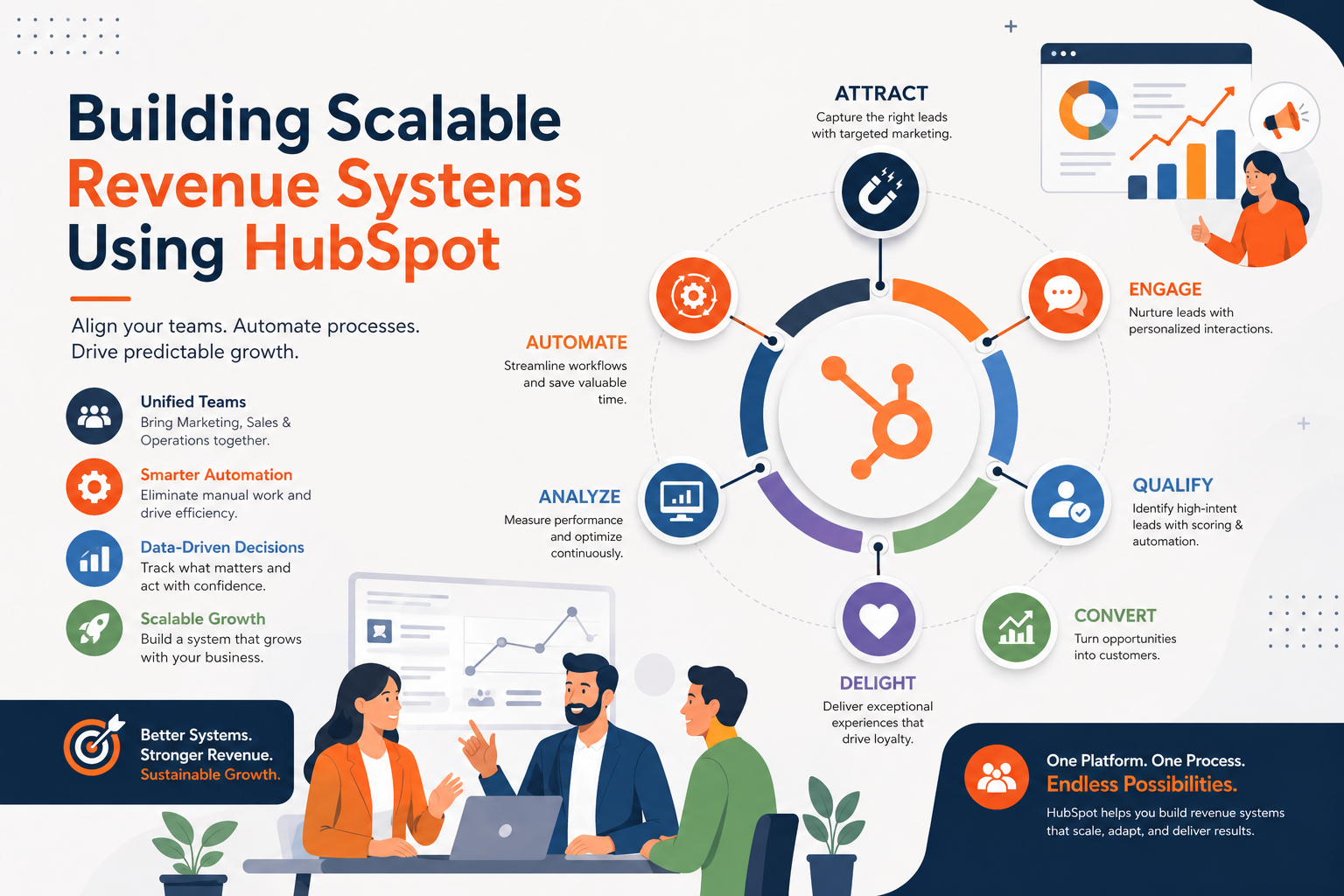
At its core, such a system includes a clearly defined customer journey, standardised lifecycle stages, automated workflows, centralised data, and a reporting mechanism that connects activities directly to revenue outcomes. The biggest difference between a traditional CRM setup and a scalable system lies in clarity and control. In a scalable system, leads are not just collected, they are guided through a journey based on behaviour and intent.
With tools like HubSpot Marketing Hub and HubSpot Sales Hub, businesses can operationalise this framework efficiently. These tools enable automation, segmentation, and tracking at scale, making it possible to handle growth without losing efficiency or visibility.
Step 1: Define Your Revenue Architecture
Before implementing any system in HubSpot, it is essential to define your revenue architecture. This is the foundation on which your entire system will operate. Revenue architecture answers critical questions such as who your ideal customers are, how they discover your business, what journey they follow before making a purchase, and what qualifies them as ready to engage with sales. Without this clarity, even the most advanced tools fail to deliver results.
Many businesses make the mistake of jumping directly into CRM setup without defining these fundamentals. This leads to confusion, inconsistent processes, and poor data quality. A well-defined revenue architecture ensures that marketing attracts the right audience, sales focuses on high-intent prospects, and operations maintain clean and actionable data.
When this foundation is in place, HubSpot becomes an execution layer rather than a decision-making tool. It simply enforces the logic you have already defined. This approach ensures that your system remains aligned with your business goals and can scale effectively as your operations grow.
Step 2: Build Lifecycle Stages That Reflect Reality
Lifecycle stages form the backbone of your revenue system. They define where a contact stands in their journey and determine how they should be treated at each stage. While many businesses adopt standard stages like Lead, MQL, SQL, Opportunity, and Customer, the real value lies in customising these stages to reflect actual buyer behaviour.
A common mistake is copying generic lifecycle models without considering how customers interact with your business. Every organisation has a unique sales cycle, and your lifecycle stages should reflect that. For example, what defines a marketing-qualified lead in one business may be very different in another. Similarly, the transition from SQL to opportunity should be based on clear and measurable criteria.
In HubSpot, lifecycle stages can be automated based on real-time behaviour such as form submissions, email interactions, and sales activities. This ensures that leads progress through the funnel based on actual engagement rather than manual updates. As a result, your system becomes more accurate, efficient, and scalable, allowing teams to focus on high-value activities instead of administrative tasks.
Step 3: Align Marketing and Sales Processes
Alignment between marketing and sales is one of the most critical components of a scalable revenue system. In many organisations, these teams operate independently, leading to miscommunication and inefficiencies. Marketing generates leads without understanding sales requirements, while sales teams struggle with unqualified or poorly nurtured prospects. This disconnect results in lost opportunities and inconsistent revenue performance.
A scalable system addresses this issue by creating a unified process where both teams operate with shared goals and definitions. This includes clearly defining qualification criteria, establishing handoff points between marketing and sales, and ensuring complete visibility into lead interactions. When both teams work within the same platform, they can access the same data and collaborate effectively.
With HubSpot, this alignment becomes seamless. Marketing activities, lead behaviour, and sales interactions are all tracked in one place. This eliminates data silos and ensures that every lead is handled consistently. The result is a smoother transition from marketing to sales, improved conversion rates, and a more predictable revenue pipeline.
Step 4: Automate Repetitive Workflows
As businesses grow, manual processes become a major bottleneck. Tasks like assigning leads, sending follow-ups, and updating records consume valuable time and are prone to human error. This not only slows down operations but also impacts the overall customer experience. Automation is essential to eliminate these inefficiencies and ensure consistency.
Using HubSpot Workflows, businesses can automate a wide range of activities. Leads can be assigned to the right sales representatives instantly, follow-up emails can be triggered based on user behaviour, and lifecycle stages can be updated automatically. Internal notifications can also be set up to ensure that no important action is missed.
Automation ensures that every lead receives timely and relevant communication without relying on manual intervention. This improves response times, enhances engagement, and increases the likelihood of conversion. More importantly, it allows teams to focus on strategic activities rather than repetitive tasks, making the entire system more efficient and scalable.
Step 5: Implement Lead Scoring for Prioritisation
Not all leads have the same potential to convert into customers. Some are actively looking for solutions, while others are still in the research phase. Without a system to differentiate between these leads, sales teams end up spending time on low-priority prospects, reducing overall efficiency.
Lead scoring provides a solution by assigning value to each lead based on predefined criteria. These criteria can include demographic information such as industry and company size, as well as behavioural data like website visits, content downloads, and email engagement. By analysing these factors, businesses can identify which leads are most likely to convert.
HubSpot offers advanced lead scoring capabilities, including predictive models that use historical data to identify high-intent prospects. This allows sales teams to focus their efforts on leads that are more likely to result in revenue. As a result, conversion rates improve, sales cycles shorten, and overall productivity increases.
Step 6: Create a Unified Reporting System
A scalable revenue system relies heavily on data-driven decision-making. Without proper reporting, businesses cannot measure performance or identify areas for improvement. This leads to guesswork and inconsistent results. A unified reporting system ensures that all key metrics are tracked and analysed in one place.
Using HubSpot Dashboards, businesses can create customised dashboards for different stakeholders. Leadership teams can access high-level insights into revenue performance, sales managers can track team productivity, and marketing teams can analyse campaign effectiveness. This ensures that everyone has access to relevant and actionable data.
A well-structured reporting system provides visibility into lead sources, conversion rates, and ROI. It helps businesses understand what is working and what is not, enabling them to make informed decisions. This level of clarity is essential for scaling operations and maintaining consistent growth over time.
Step 7: Continuously Optimise the System
A revenue system is not a one-time setup. It requires continuous optimisation to remain effective. As markets evolve and customer behaviour changes, businesses need to adapt their strategies and processes accordingly. Without regular updates, even the most well-designed system can become outdated.
Continuous optimisation involves testing new campaigns, refining lead scoring models, improving conversion paths, and updating automation workflows. It also includes analysing performance data to identify trends and areas for improvement. With HubSpot, businesses can track every interaction and gain valuable insights into customer behaviour.
This iterative approach ensures that the system remains aligned with business goals and market conditions. It also allows businesses to identify opportunities for growth and implement changes quickly. Over time, this leads to a more efficient and effective revenue system that can support long-term scalability.
Conclusion: Building a Predictable Growth Engine
Building a scalable revenue system using HubSpot is not about adding complexity or using every available feature. It is about creating a structured and connected system that aligns your teams and processes. When done correctly, it transforms your CRM into a powerful growth engine. Leads are managed efficiently, teams work in alignment, and decisions are based on real data. This creates a predictable and scalable revenue model that supports long-term growth. If your current system feels chaotic or inconsistent, the issue is not demand. It is the lack of structure.
At HuboExperts, we focus on building governance-first systems that bring clarity and control to your operations. Because sustainable growth does not come from doing more, it comes from building systems that work consistently at scale.

