

Every Change to HubSpot Credits Pricing in 2026, Tracked
HubSpot is rapidly expanding the role of artificial intelligence across its customer platform. Features such as AI agents, automated prospecting, customer support automation, smart data capture, record enrichment, and custom AI workflows can now perform work that previously required significant manual effort.
However, many of these capabilities are no longer governed only by your HubSpot subscription or seat count. They are increasingly powered by a usage-based system known as HubSpot Credits.
During 2026, HubSpot introduced several important changes to how credits are allocated, consumed, purchased, and controlled. Businesses using Breeze AI, HubSpot agents, smart data capture, and other AI-powered features should understand these changes before scaling their usage.
.png?width=493&height=258&name=www.huboexperts.com%20(8).png)
This guide explains the HubSpot Credits pricing changes for 2026, including included allowances, additional credit pricing, automatic upgrades, pay-as-you-go billing, AI agent costs, and practical ways to manage your monthly spend.
Quick Recap: What HubSpot Credits Are
HubSpot Credits are the usage-based currency behind Breeze, HubSpot's AI layer. Every paid Hub bundles a monthly credit allowance, and once you burn through it, you either auto-upgrade to a bigger tier or pay as you go for more. The system sits on top of HubSpot's broader seat-based pricing model, which HubSpot introduced back in March 2024 and has continued rolling out to legacy accounts at renewal throughout 2026.
Baseline credit allocations, unchanged for most of 2026:
-
Marketing, Sales, Service, Content Hub, and Smart CRM: 500 credits (Starter), 3,000 (Professional), 5,000 (Enterprise)
-
Data Hub and Customer Platform bundles: 500 (Starter), 5,000 (Professional), 10,000 (Enterprise)
-
Unused credits do not roll over month to month
Standard purchase rate for extra credits has held at $10 per 1,000 ($0.010 per credit), with an annual-commitment rate closer to $9 per 1,000 in several published breakdowns. Pay-As-You-Go overage is invoiced in blocks of 10 credits at the same $0.010 rate, and HubSpot's Product & Services Catalog confirms that if usage exceeds your monthly limit, the account auto-upgrades unless you've switched on Pay-As-You-Go instead.
The Timeline: What Actually Changed in 2026
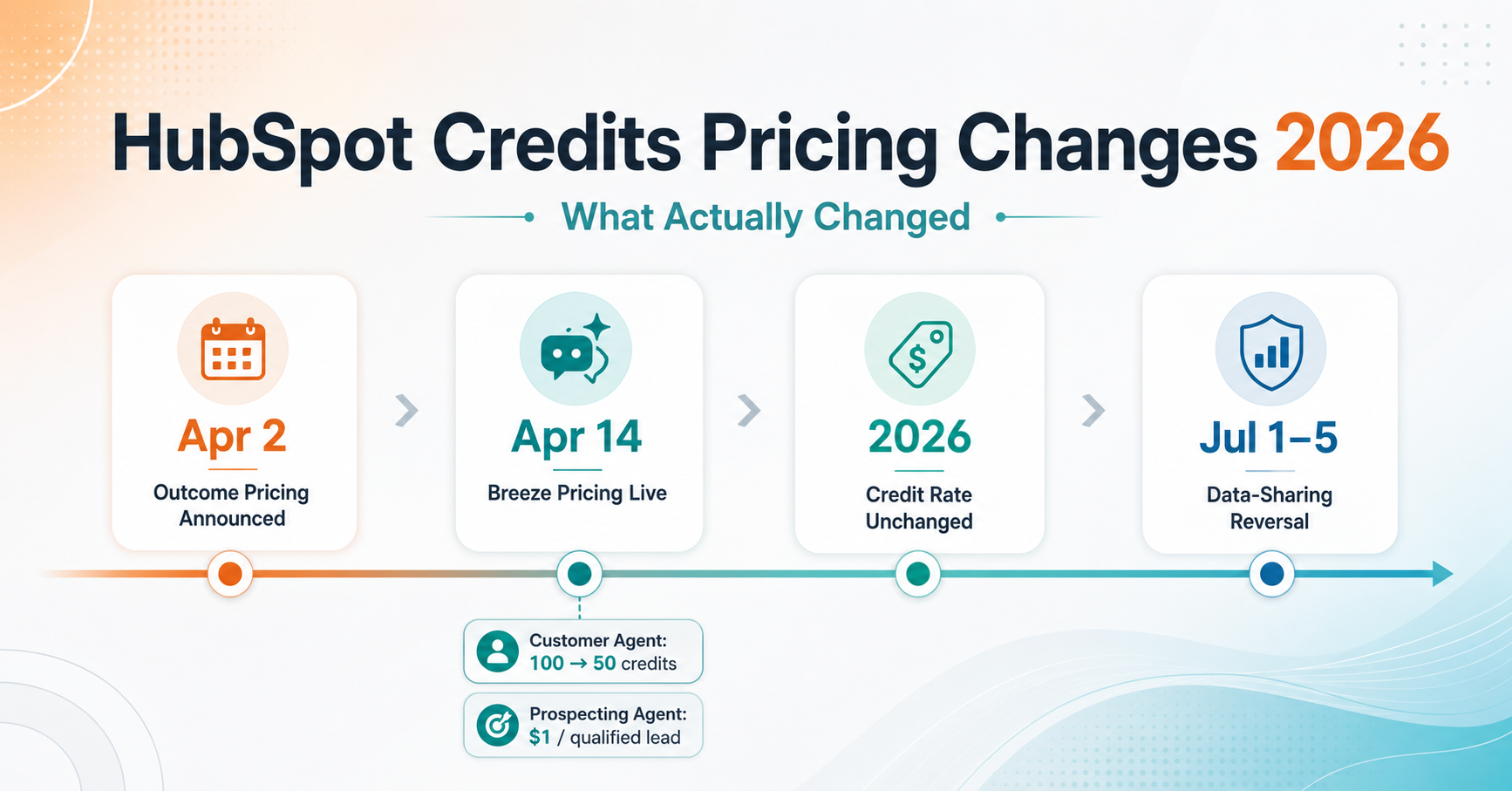
April 2, 2026 — HubSpot Announces Outcome-Based Credit Pricing
HubSpot notified customers, including a direct email to early Prospecting Agent adopters, that two flagship Breeze agents were switching pricing models effective April 14. The stated goal was to tie cost directly to results rather than activity, following a broader industry shift toward outcome-based AI pricing also seen at Zendesk, Intercom, and Salesforce.
April 14, 2026 — The Change Goes Live (No Opt-Out, No Grandfathering)
This is the single biggest credits pricing change of the year, and it hit every customer on the same date with no exceptions:
Breeze Customer Agent:
-
Old model: $1.00 (100 credits) per conversation, charged whether or not the agent actually resolved anything
-
New model: $0.50 (50 credits) per resolved conversation only
HubSpot defines a "resolution" as a conversation the agent handled without escalating to a human rep within 72 hours (or one where the agent qualifies a lead). Come back after 72 hours and it counts as a fresh, separately billed conversation — a detail that matters more than the headline 50% price cut suggests.
Breeze Prospecting Agent:
-
Old model: a recurring monthly charge per contact enrolled — free during the early-adopter period
-
New model: $1.00 (100 credits) per qualified lead
actually recommended for outreach, not per contact monitored
Both agents also picked up a free 28-day trial for Professional and Enterprise customers, and Prospecting Agent gained new controls — Company Enrollment (public beta), Lead Cap limits, and 30-day auto-unenrollment — aimed at preventing surprise credit burn under the new model.
Net effect: for most support teams, the bill goes down, since you're no longer paying for conversations the AI never actually closes. For prospecting, previously-free early adopters now see a real credit cost tied to qualified leads for the first time.
Ongoing Through 2026 — The Credit Rate Itself Hasn't Moved
Despite two consumption-side changes above, the sticker price of a HubSpot Credit has stayed put across 2026: $10 per 1,000 standard, roughly $9 per 1,000 on annual terms, $0.010 per credit for Pay-As-You-Go overage. What changed was consumption per action (100 credits → 50 credits for Customer Agent) and the billing trigger (per attempt → per outcome), not the underlying exchange rate.
Data Hub enrichment sits on a related but separate usage meter: overage beyond your included allocation runs about $0.010 per record, which can turn a flat Data Hub subscription into a usage-driven line item for teams enriching thousands of records a month.
July 1–5, 2026 — The Data-Sharing Reversal (Adjacent, Not a Credits Price Change)
This one is worth flagging even though it didn't touch the credit rate card. On July 1, HubSpot updated its Customer Terms of Service, Privacy Policy, and related legal pages to prepare for a new feature called Contact Discovery — a shared enrichment dataset that would pool business-contact data across customer accounts, opt-out by default. The backlash was immediate and loud enough that by July 5, CPTO Duncan Lennox posted "We Got This Wrong. And We Are Fixing It," fully withdrawing the July 1 terms changes. HubSpot committed that any future version of shared enrichment would be opt-in from the start.
Why it matters for a credits post: Contact Discovery was positioned as an extension of HubSpot's credit-metered enrichment and prospecting tools. The reversal didn't change any credit pricing, but it's a reminder that the terms governing how those AI and data features work can move faster than the price list does — worth checking at every contract renewal.
What This Means for Your HubSpot Bill
-
Support-heavy teams using Breeze Customer Agent likely saw costs drop after April 14, since failed or escalated conversations no longer bill at all.
-
Sales teams using Prospecting Agent, especially early adopters used to it being free, now need to budget for a real per-lead cost and should use the new Lead Cap controls to avoid surprise overage.
-
Everyone should still treat $10/1,000 ($9 annual) as the working credit rate for 2026 — that number hasn't moved, only what gets billed against it.
-
Data Hub users doing heavy enrichment should model the $0.010/record overage separately, since it scales differently from Breeze agent credits.
Pricing pages, credit allocations, and terms of service can all shift on short notice, as 2026 has shown twice already. Confirm current numbers directly in your HubSpot portal or a written quote before budgeting, rather than relying on any single article — including this one.
Final Thoughts
The 2026 HubSpot Credits changes represent a broader shift towards usage-based and outcome-based AI pricing.
Customers are no longer paying only for access to HubSpot software. Increasingly, they are also paying according to the volume of work completed by AI agents, automated data tools, and intelligent workflows.
This creates more flexibility, but it also introduces a new layer of cost management.
Before scaling HubSpot AI, businesses should review their included allowance, identify every feature consuming credits, establish monthly limits, and connect each use case with a measurable commercial outcome.
With the right governance, HubSpot Credits can help teams reduce manual work and scale efficiently. Without careful configuration, they can create unexpected costs and interruptions across important sales, marketing, and service processes.
At HuboExperts, we help businesses audit their HubSpot setup, forecast AI-credit usage, configure agent limits, and build automation systems that deliver measurable value without unnecessary consumption.
Frequently Asked Questions
1. Did the price of a HubSpot Credit go up in 2026?
No. The per-credit rate has stayed at roughly $10 per 1,000 standard ($9 per 1,000 on annual terms) throughout 2026. What changed was how many credits certain actions consume and when they're billed, not the credit's underlying price.
2. What was the biggest HubSpot Credits change in 2026?
The April 14, 2026 shift to outcome-based pricing for Breeze Customer Agent and Breeze Prospecting Agent. Customer Agent moved from 100 credits per conversation to 50 credits per resolved conversation, and Prospecting Agent moved from a free/monthly model to 100 credits per qualified lead.
3. How does HubSpot define a "resolved" conversation for billing?
A conversation counts as resolved if the Breeze Customer Agent handled it without escalating to a human rep within 72 hours, or if the agent qualifies a lead during the interaction. If it's handed off within that window, it isn't billed as resolved.
4. Is Breeze Prospecting Agent still free?
No. As of April 14, 2026, it charges 100 credits ($1) per lead recommended for outreach. It was free during its earlier adopter phase, but that period ended with the April pricing change.
5. How many HubSpot Credits do I get on each plan?
For most Hubs (Marketing, Sales, Service, Content, Smart CRM): 500 on Starter, 3,000 on Professional, 5,000 on Enterprise. For Data Hub and Customer Platform bundles, allocations run higher: 500, 5,000, and 10,000 respectively.
6. Do unused HubSpot Credits roll over to the next month?
No. Credit allowances reset monthly and unused credits are forfeited rather than carried forward.
7. What happens if I go over my monthly credit limit?
By default, your account auto-upgrades to a higher credit tier so work isn't interrupted. You can switch this to Pay-As-You-Go instead, which bills overage at $0.010 per credit in increments of 10 credits without permanently upgrading your plan.
8. Was the July 2026 HubSpot terms of service change related to credits pricing?
Not directly. That episode involved a proposed shared enrichment dataset (Contact Discovery) and default opt-in data sharing, which HubSpot fully reversed within four days after customer backlash. It didn't change any credit rates, but it touched the same enrichment features that consume credits.
9. How much does Data Hub enrichment cost beyond the included allocation?
Overage runs about $0.010 per enriched record once you exceed your plan's included credit pool, which can make Data Hub costs scale closely with how many records you enrich each month.
10. Should I expect more HubSpot Credits pricing changes later in 2026?
HubSpot hasn't published a fixed cadence for pricing changes, and 2026 has already shown it's willing to adjust both consumption models and terms with short notice. The safest approach is to check HubSpot's official Product and Services Catalog and billing notices directly rather than assuming current rates are locked in for the rest of the year.

