

10 HubSpot Agency Capabilities That Actually Improve Lead Nurturing
If your pipeline feels like a leaky funnel — leads coming in the top, but too few qualified conversations happening at the bottom — the problem usually isn't lead volume. It's what happens between the first click and the first sales call. That gap is where lifecycle automation lives, and it's the single biggest differentiator between HubSpot agencies that generate reports and HubSpot agencies that generate revenue.
Growth-focused marketing teams evaluating HubSpot consulting partners often start by comparing price, portfolio, or HubSpot tier certifications. Those matter, but they don't tell you whether an agency can actually build a lifecycle engine that nurtures leads consistently and hands them to sales at the right moment. This guide breaks down the ten capabilities that separate agencies who understand marketing automation and sales automation as a connected system from agencies who only know how to send emails.
-2.png?width=1200&height=628&name=www.huboexperts.com%20(2)-2.png)
Use this as a scorecard the next time you're vetting HubSpot agencies for a lifecycle automation project.
1. Lifecycle Stage Mapping & Governance
Before any workflow gets built, a capable HubSpot agency should sit down with both marketing and sales to define what a Marketing Qualified Lead (MQL), Sales Qualified Lead (SQL), and Sales Qualified Opportunity actually mean for your business. This sounds basic, but it's the most commonly skipped step — and skipping it is why so many lead nurturing programs fail quietly.
Strong agencies document lifecycle stage definitions, get sign-off from both teams, and build governance rules into HubSpot so records move automatically based on real behavior instead of manual updates. Ask any agency you're evaluating to walk you through how they'd define and enforce your lifecycle stages before they touch a single workflow.
2. Multi-Channel Lead Scoring Models
Generic scoring — "email open = 5 points, form fill = 10 points" — doesn't reflect how buyers actually behave today. A HubSpot agency worth hiring builds scoring models that weigh signals across channels: website revisits, content downloads, ad engagement, chatbot conversations, and even negative signals like unsubscribes or job title mismatches.
Look for agencies that build tiered or predictive scoring rather than a single flat number, and that revisit the model quarterly as your ideal customer profile evolves. A scoring model built once and never touched again is a liability, not an asset.
3. Behavior-Triggered Workflow Automation
This is the core of lead nurturing: workflows that respond to what a lead actually does, not a fixed calendar. Instead of "send email 3 on day 7 no matter what," mature marketing automation reacts — someone who visits the pricing page three times in a week should get a different nurture path than someone who downloaded one ebook and went quiet.
The best HubSpot agencies design branching logic that adjusts messaging, cadence, and channel based on engagement, and they build in exit criteria so leads don't keep receiving nurture emails after they've already booked a call.
4. Sales & Marketing Handoff Automation (SLAs)
Lead nurturing only pays off if the handoff to sales is clean. This is where sales automation and marketing automation need to work as one system, not two disconnected tools. Agencies with real lifecycle automation experience build automated lead routing, instant notifications, and enforced Service Level Agreements (SLAs) — for example, auto-escalating a lead if a rep hasn't followed up within an hour.
When you're comparing HubSpot agencies, ask specifically how they've automated handoffs in past projects. Vague answers here are a red flag; this is usually where the most measurable ROI shows up.
5. Dynamic List Segmentation
Static lists go stale the moment they're built. Growth-focused teams need segmentation that updates automatically as contacts meet or drop out of criteria — by industry, deal stage, engagement recency, or lifecycle stage. A skilled HubSpot consulting partner builds active lists layered with smart filters so your nurture campaigns are always targeting the right audience without manual list maintenance.
This capability also underpins personalization at scale, which is where the next capability comes in.
6. Personalized Email Nurture Sequences
Personalization beyond "Hi " is what actually moves leads through the funnel. Agencies that do this well use dynamic content blocks, industry-specific messaging, and smart CTAs that change based on a contact's lifecycle stage or previous engagement.
Ask prospective agencies for examples of nurture sequences they've built — not just subject lines, but the underlying logic. A strong sequence typically includes a mix of educational content, proof points, and low-friction conversion offers, sequenced deliberately rather than dumped in a generic drip.
7. Lead Rotation & Territory Automation
For teams with multiple reps, territories, or verticals, manual lead assignment creates delays and inconsistency. Capable agencies configure automated lead rotation based on territory, deal size, product line, or rep capacity — often using round-robin or weighted assignment logic within HubSpot.
This is a smaller-sounding capability, but it has an outsized effect on speed-to-lead, which remains one of the strongest predictors of conversion rate in B2B sales automation.
8. CRM Data Hygiene & Deduplication Automation
Lifecycle automation is only as good as the data underneath it. Duplicate records, inconsistent property values, and orphaned contacts quietly break scoring models and routing rules. Agencies that take this seriously build automated deduplication workflows, standardize property formatting, and set up validation rules to stop bad data at the point of entry — forms, integrations, and imports.
If a HubSpot agency doesn't ask about your current data quality during a discovery call, that's worth noting.
9. Attribution & Funnel Reporting Dashboards
You can't improve what you can't see. Strong agencies build custom reporting that ties lead nurturing activity to actual revenue outcomes — not just email open rates, but which nurture paths, content assets, and channels are producing SQLs and closed-won deals. Multi-touch attribution reporting inside HubSpot lets marketing teams defend budget and prioritize what's actually working.
This capability is what turns lifecycle automation from a "set it and forget it" project into a system your team can keep improving.
10. Ongoing Optimization via A/B Testing & Workflow Audits
The best HubSpot agencies don't consider a lifecycle automation build "done" at launch. They schedule recurring audits of workflows, scoring models, and email performance, and they run structured A/B tests on subject lines, send times, and content sequencing. Marketing automation platforms decay in performance over time as buyer behavior shifts — ongoing optimization is what keeps nurture programs effective a year or two after the initial implementation.
When evaluating HubSpot agencies, ask what their post-launch engagement actually looks like. A one-time build with no optimization plan is usually a warning sign.
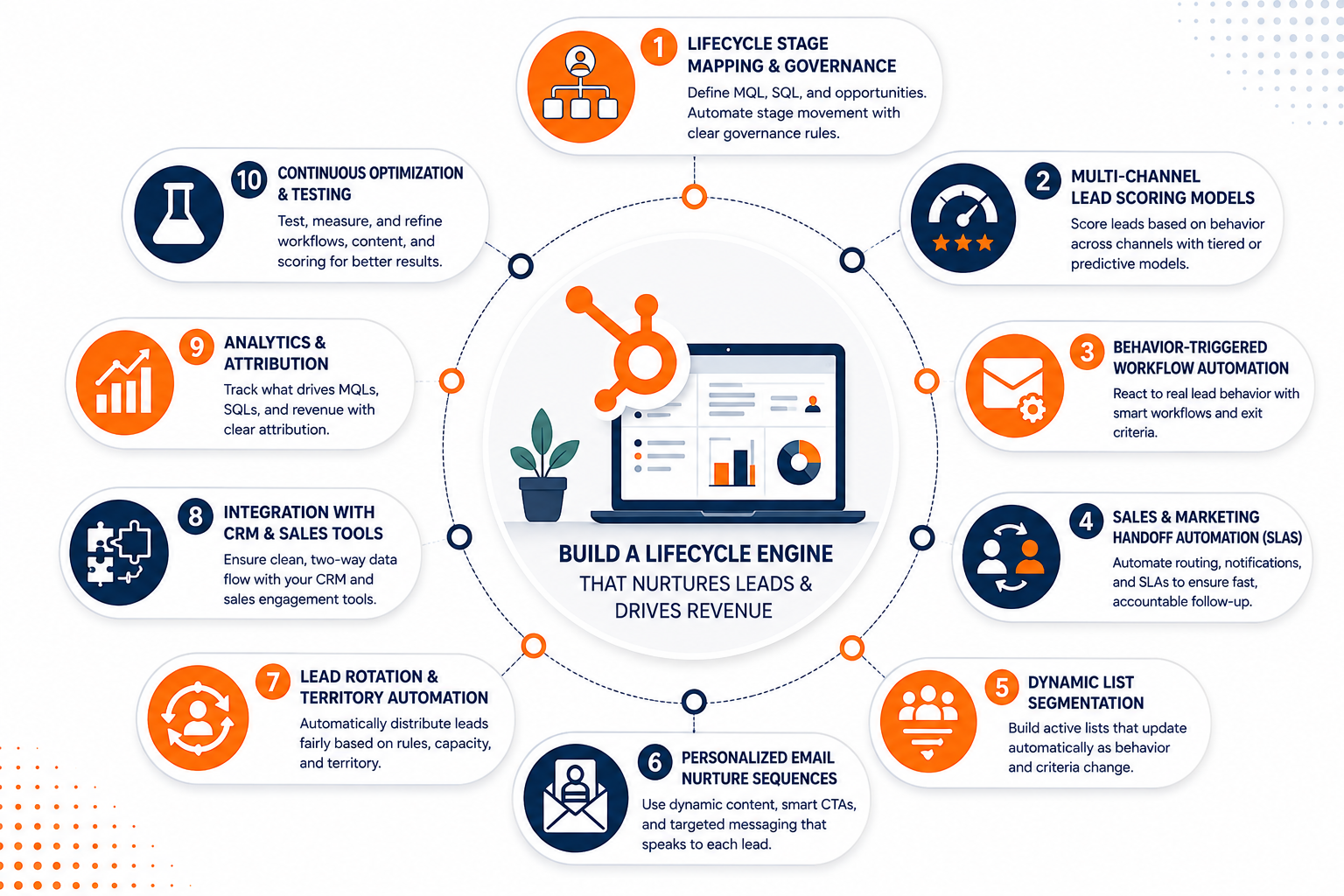
Choosing the Right HubSpot Agency for Lifecycle Automation
Taken together, these ten capabilities describe a HubSpot agency that treats lead nurturing as a connected system — spanning marketing automation,sales automation, and the data infrastructure that supports both — rather than a collection of disconnected email workflows. When you're comparing HubSpot consulting partners, use this list as a working scorecard during discovery calls. Ask for specific examples, not general capability claims, and pay close attention to how each agency talks about the handoff between marketing and sales, since that's where most lead nurturing programs quietly lose value.
Strong HubSpot implementation partners will welcome these questions. If an agency can't speak concretely to lifecycle stage governance, scoring methodology, or handoff SLAs, it's a sign their experience may be limited to campaign execution rather than full lifecycle automation.
Conclusion
Lead nurturing doesn't fail because teams lack tools — it fails because those tools aren't connected into a system. At HuboExperts, we've seen the same pattern across dozens of HubSpot implementations: agencies that check the boxes on lifecycle stages, lead scoring, and workflows, but never wire them together into something that actually moves revenue.
The ten capabilities in this guide aren't a wishlist — they're the baseline for a lifecycle automation program that works the way your funnel actually works: dynamically, based on real buyer behavior, with a clean handoff from marketing to sales at exactly the right moment.
If you're evaluating HubSpot agencies right now, don't settle for a portfolio and a certifications page. Ask the harder questions — how they'll define your lifecycle stages, how they'll build and maintain your scoring model, how they'll automate your SLAs, and what happens after launch. The answers will tell you more than any case study.
At HuboExperts, this is the work we do every day: building lifecycle engines inside HubSpot that turn lead volume into qualified pipeline — not just reports. If your current nurture program feels more like a leaky funnel than a growth engine, let's talk about what a connected system could look like for your team.
Ready to turn your funnel into a lifecycle engine?
Book a free HubSpot audit with HuboExperts and see exactly where your lead nurturing is leaking revenue — and how to fix it.
Frequently Asked Questions
1. What does a HubSpot agency actually do for lead nurturing?
A HubSpot agency designs and builds the automated workflows, scoring models, and segmentation logic that move leads from initial interest to sales-ready, using behavior-based triggers instead of manual follow-up.
2. How is lifecycle automation different from basic email marketing?
Lifecycle automation responds to a contact's real-time behavior and lifecycle stage, while basic email marketing typically sends the same fixed sequence to everyone regardless of engagement.
3. What is lead scoring, and why does it matter for nurturing?
Lead scoring assigns point values to a contact's actions and attributes so marketing and sales can prioritize outreach toward the leads most likely to convert, rather than treating every lead equally.
4. How do HubSpot agencies improve the marketing-to-sales handoff?
They build automated routing rules, instant notifications, and enforced follow-up SLAs so qualified leads reach a sales rep quickly instead of sitting in a shared inbox or spreadsheet.
5. What is a Marketing Qualified Lead (MQL) versus a Sales Qualified Lead (SQL)?
An MQL is a contact marketing has identified as engaged enough to warrant sales attention, while an SQL is a lead sales has vetted and accepted as worth actively pursuing.
6. Why does CRM data hygiene matter for marketing automation?
Automation rules, scoring models, and routing logic all depend on accurate data; duplicate or inconsistent records cause leads to be scored incorrectly, routed to the wrong rep, or missed entirely.
7. How often should lead nurturing workflows be reviewed or updated?
Most growth-focused teams should audit workflows and scoring models quarterly, since buyer behavior, product offerings, and sales priorities shift over time.
8. Can small marketing teams benefit from HubSpot lifecycle automation?
Yes; smaller teams often see the largest relative time savings, since automation replaces manual list building, lead assignment, and follow-up reminders that would otherwise fall on one or two people.
9. What questions should I ask a HubSpot agency before hiring them?
Ask how they define lifecycle stages, how they build and update scoring models, how they've automated sales handoffs in past projects, and what ongoing optimization looks like after launch.
10. How long does it typically take to implement a full lifecycle automation system?
Timelines vary by complexity, but most HubSpot implementation projects covering lifecycle stages, scoring, workflows, and reporting take between six and twelve weeks from discovery to launch.

