

Introduction: Why Growth Feels Unpredictable
Many businesses experience growth in phases. Some months are strong, others are slow, and often there is no clear reason behind the fluctuations. This unpredictability is not usually caused by lack of demand. It is caused by the absence of a structured system that connects marketing, sales, and operations.
Leads come in, but they are not nurtured properly. Sales teams follow different approaches. Data is scattered across tools, making it difficult to understand what is actually working. As a result, decisions are based on assumptions rather than insights. This is where a structured framework becomes essential.
Using HubSpot CRM, businesses can build a system that creates consistency. Instead of relying on random outcomes, they can design a process where every lead follows a defined journey and every action contributes to revenue. Predictable growth is not about doing more. It is about building a system that works every time.
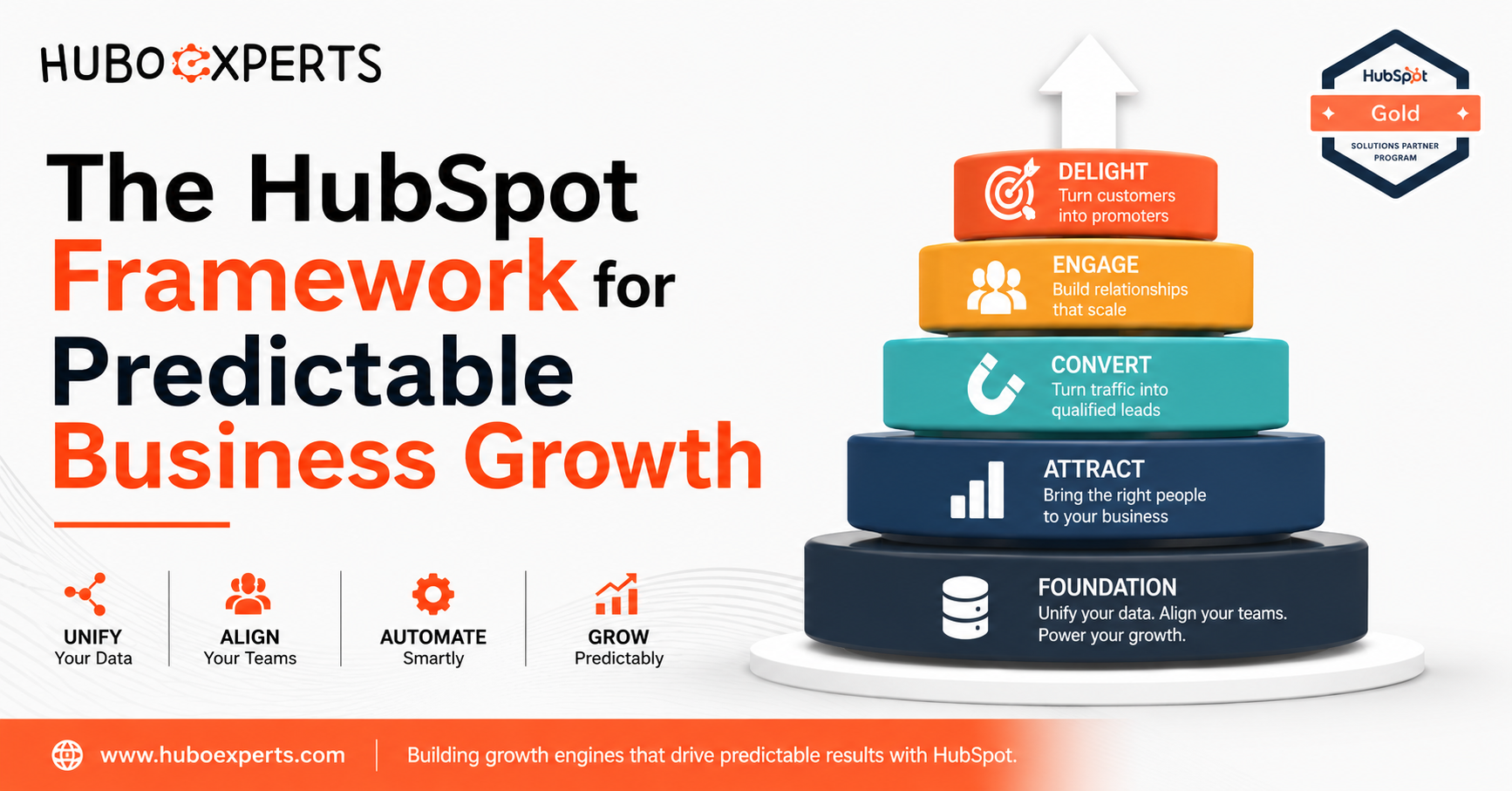
Predictable growth is not built on campaigns. It is built on systems that turn every interaction into revenue.
What Is the HubSpot Growth Framework
The HubSpot Growth Framework is a structured approach to managing the complete customer journey, from the very first interaction to long-term retention and advocacy. It is built to bring alignment across marketing, sales, and operations, ensuring that every team works within a unified system rather than in silos. Instead of handling leads in a fragmented way, the framework creates a seamless experience where every interaction is connected and contributes to a larger revenue goal.
At its core, the framework revolves around six interconnected stages: attract, engage, qualify, convert, delight, and analyse. These stages represent the full lifecycle of a customer and ensure that no part of the journey is overlooked. What makes this framework powerful is that it does not treat marketing and sales as separate functions but integrates them into a continuous process where data flows freely and decisions are based on real insights. With platforms like HubSpot Marketing Hub and HubSpot Sales Hub, businesses can manage all these stages within a single ecosystem, eliminating data silos and improving efficiency. This unified approach ensures that every action is measurable, every lead is tracked properly, and growth becomes predictable, scalable, and sustainable over time.
Stage 1: Attract the Right Audience
Growth starts with attracting the right audience, not just more traffic. Many businesses focus on increasing website visits or running more ads, but if the audience is not aligned with their offering, conversions will remain low. The attract stage is about identifying your Ideal Customer Profile and creating targeted strategies to reach them. This includes SEO, paid campaigns, social media, and content marketing. The goal is to bring in people who are genuinely interested in your solution.
HubSpot helps streamline this process by tracking traffic sources, campaign performance, and user behaviour. This allows businesses to understand which channels are driving high-quality leads and which ones need optimisation. By focusing on quality over quantity, businesses can build a strong foundation for the rest of the funnel. Attracting the right audience ensures that downstream efforts in nurturing and conversion become significantly more effective.
Stage 2: Engage with Meaningful Interactions
Once you attract the right audience, the next step is engagement. This is where most businesses lose potential customers. They either overwhelm users with generic communication or fail to follow up at the right time. Engagement is about building trust through relevant and timely interactions. This includes personalised emails, targeted content, chat interactions, and remarketing campaigns. The objective is to keep prospects interested and move them closer to a buying decision.
HubSpot enables businesses to automate and personalise engagement at scale. Based on user behaviour, it can trigger specific actions such as sending follow-up emails or recommending content. This ensures that every interaction feels relevant rather than random. When done correctly, engagement builds a relationship with the prospect, making them more likely to convert in the later stages of the funnel.
Stage 3: Qualify Leads with Data, Not Assumptions
Not every engaged lead is ready to buy. Some are still exploring, while others may not be a good fit at all. Without proper qualification, sales teams waste time on leads that are unlikely to convert. The qualify stage focuses on identifying high-intent prospects using data. This is typically done through lead scoring, which assigns value to leads based on their demographics and behaviour.
HubSpot offers both manual and predictive lead scoring models. It analyses factors such as website activity, email engagement, and company details to determine how likely a lead is to convert. This allows sales teams to prioritise their efforts effectively. Instead of chasing every lead, they can focus on those who show strong buying signals. Qualification brings clarity and efficiency to the sales process, ensuring that resources are used where they have the highest impact.
Stage 4: Convert Opportunities into Revenue
Conversion is where all your previous efforts come together. However, many businesses struggle at this stage due to inconsistent sales processes and lack of visibility. A strong conversion system includes clearly defined pipelines, standardised deal stages, and structured follow-ups. Every opportunity should follow a consistent path from initial conversation to closed deal.
With HubSpot, sales teams can manage deals through visual pipelines, track interactions, and automate follow-ups. This ensures that no opportunity is missed and every lead is handled systematically. Conversion is not just about closing deals. It is about creating a repeatable process that delivers consistent results. When your sales system is structured, forecasting becomes easier and revenue becomes more predictable.
Stage 5: Delight Customers for Long-Term Growth
Many businesses stop focusing on customers after the deal is closed. This is a missed opportunity. Retention and expansion are key drivers of long-term growth. The delight stage focuses on delivering exceptional customer experiences. This includes onboarding, support, personalised communication, and continuous engagement. Happy customers are more likely to stay, upgrade, and refer others.
HubSpot allows businesses to track customer interactions and create automated workflows for onboarding and follow-ups. This ensures that customers feel supported throughout their journey. Delighting customers turns them into advocates. Instead of constantly chasing new leads, businesses can generate growth through referrals and repeat business.
Stage 6: Analyse and Optimise Continuously
The final stage of the framework is analysis. Without data, businesses cannot understand what is working and what needs improvement. This stage involves tracking key metrics such as conversion rates, campaign performance, sales efficiency, and customer retention. The goal is to gain insights that can be used to optimise the system.
Using HubSpot Dashboards, businesses can create customised reports for different teams. This ensures that everyone has access to relevant data and can make informed decisions. Continuous optimisation is what makes growth predictable. By regularly analysing performance and making improvements, businesses can refine their processes and achieve better results over time.
Common Challenges in Implementing the Framework
1. Lack of Clear Strategy Before Implementation
One of the biggest challenges businesses face is jumping into tools without defining a clear strategy. They start setting up pipelines, workflows, and campaigns in HubSpot CRM without first understanding their customer journey, revenue model, or qualification criteria. This leads to a system that looks structured on the surface but lacks depth and direction. As a result, teams end up reworking processes again and again, causing delays and frustration. A framework only works when it is built on strong business logic, not assumptions.
2. Poor Data Quality and Data Hygiene Issues
Data is the backbone of any CRM system, and poor data quality can completely break the framework. Duplicate contacts, missing information, inconsistent property usage, and outdated records create confusion across teams. When sales and marketing cannot trust the data, they stop relying on the system altogether. Over time, this leads to low adoption and inaccurate reporting. Maintaining clean, structured, and standardised data is essential for ensuring that the framework functions effectively.
3. Misalignment Between Marketing and Sales Teams
A common issue is the disconnect between marketing and sales. Marketing focuses on generating leads, while sales focuses on closing deals, but without a shared definition of what qualifies a lead, the system fails. Leads may be passed too early, too late, or without proper context. This creates friction, delays, and lost opportunities. The HubSpot framework requires both teams to operate with shared goals, definitions, and visibility. Without alignment, even the best tools cannot deliver predictable growth.
4. Overcomplicating Workflows and Automation
Automation is powerful, but overusing it can create unnecessary complexity. Many businesses build too many workflows without clear logic, leading to overlapping triggers, conflicting actions, and hard-to-manage systems. Instead of simplifying operations, automation becomes a source of confusion. A scalable system should focus on simplicity and clarity. Every workflow should have a defined purpose and measurable outcome. Overcomplication not only slows down the system but also makes troubleshooting difficult.
5. Lack of Proper Lifecycle and Lead Status Definitions
Another major challenge is not defining lifecycle stages and lead statuses properly. Businesses often use default stages without customising them to match their actual sales process. This results in inaccurate tracking and poor handoffs between teams. Without clear definitions, leads get stuck, skipped, or misclassified. A strong framework requires lifecycle stages that reflect real buyer behaviour and clear criteria for moving leads from one stage to another.
6. Low Team Adoption and Resistance to Change
Even the best system fails if the team does not use it properly. Resistance to change is a common issue, especially when teams are used to working in their own way. Sales teams may avoid updating CRM records, and marketing teams may not fully utilise automation tools like HubSpot Marketing Hub. This leads to incomplete data and broken processes. Proper training, onboarding, and ongoing support are essential to ensure that teams understand the value of the system and use it consistently.
7. Lack of Ownership and Governance
Many businesses do not assign clear ownership of the CRM and revenue system. Without a dedicated person or team responsible for maintaining and optimising the system, processes become inconsistent over time. Workflows break, data becomes messy, and reporting loses accuracy. Governance is critical for long-term success. A structured approach with defined roles, responsibilities, and regular audits ensures that the system remains aligned with business goals.
8. Inadequate Reporting and Lack of Visibility
Without proper reporting, businesses cannot measure the effectiveness of their framework. Many organisations either track too many metrics without clarity or fail to track the right ones. This leads to confusion and poor decision-making. Using tools like HubSpot Dashboards, businesses should focus on key metrics such as conversion rates, pipeline velocity, and campaign ROI. Clear visibility ensures that decisions are based on data, not guesswork.
9. Treating HubSpot as a Tool, Not a System
A critical mistake is treating HubSpot as just another software rather than a complete revenue system. Businesses often use it only for storing contacts or sending emails, missing out on its full potential. The real value lies in connecting marketing, sales, and operations into one unified framework. When used strategically, HubSpot becomes the backbone of business growth. When used tactically, it becomes just another tool with limited impact.
10. Lack of Continuous Optimisation
Many businesses treat implementation as a one-time project. Once the system is set up, they stop improving it. However, markets change, customer behaviour evolves, and strategies need to adapt. Without continuous optimisation, the system becomes outdated and less effective over time. Regular audits, performance reviews, and updates are necessary to keep the framework aligned with business objectives. A scalable system is one that evolves continuously, not one that remains static.
Conclusion: Turning Growth into a System
Predictable business growth is not achieved through shortcuts or isolated efforts. It comes from building a system where every part of the customer journey is connected and optimised.
The HubSpot framework provides a structured approach to achieving this. By aligning marketing, sales, and operations, businesses can create a seamless experience for their customers and a consistent revenue stream for themselves.
At HuboExperts, we focus on implementing governance-first systems that bring clarity, efficiency, and scalability. Because in the end, growth is not about luck. It is about building a system that delivers results consistently.

