

Enterprise HubSpot + AI: A Governance Framework for Multi-Team Rollouts
For a single-team HubSpot instance, adopting AI features is straightforward: flip on Breeze, let marketing experiment with content generation, and iterate. But once you're running HubSpot across marketing, sales, customer success, RevOps, and sometimes multiple business units or regions, that same casual approach turns into a liability fast.
Duplicate workflows fire AI-generated emails from three different teams. Sales reps rely on AI-scored leads that RevOps configured differently than intended. A customer success playbook trained on outdated data starts recommending the wrong next steps. None of these are hypothetical — they're the predictable result of enabling powerful automation without shared rules for how it gets used.
.png?width=1200&height=628&name=www.huboexperts.com%20(5).png)
This is where governance stops being a "nice to have" and becomes the difference between AI that compounds value across your GTM engine and AI that quietly erodes trust in your CRM data.
Why "Just Turn On the AI Features" Doesn't Work at Scale
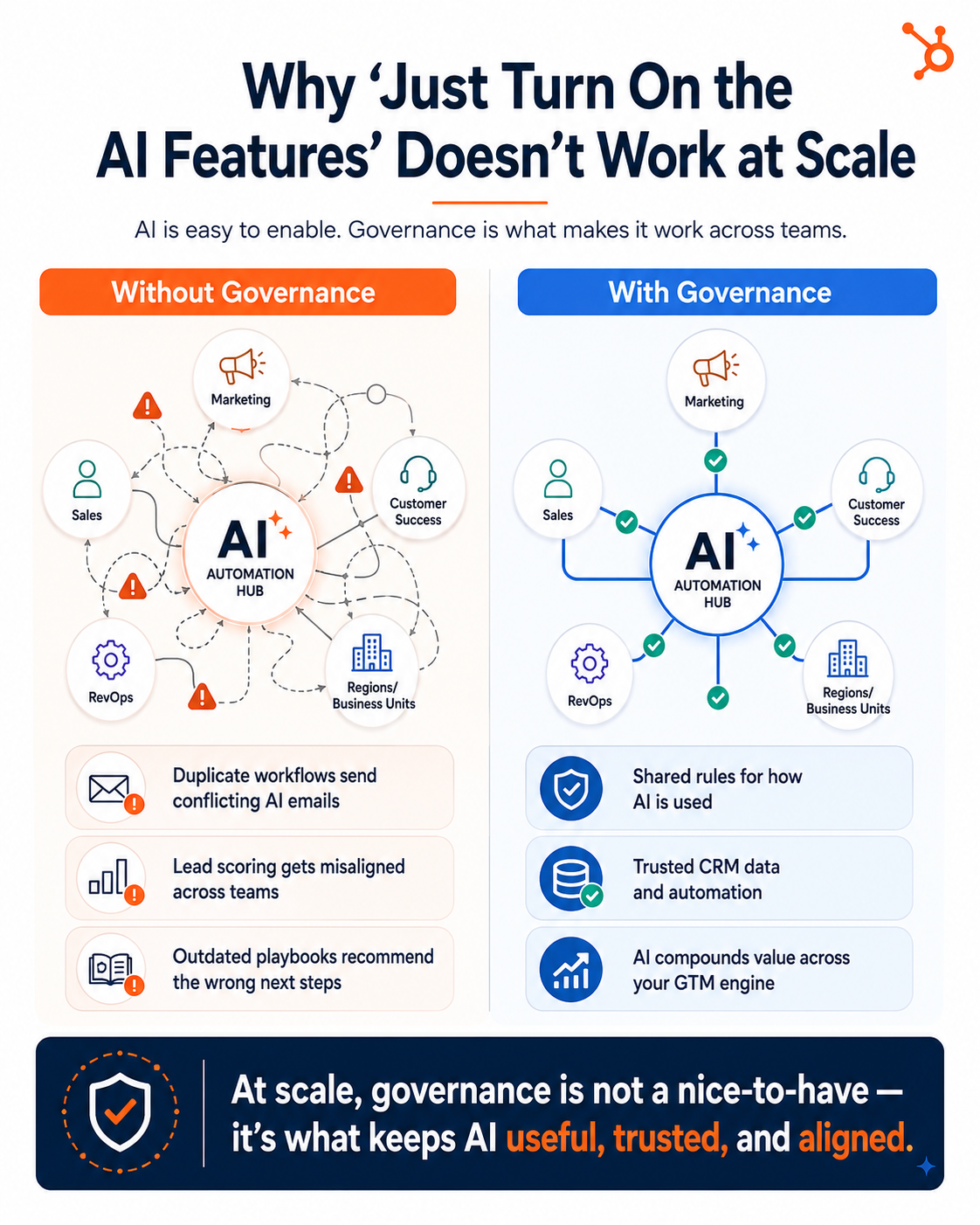
For a single-team HubSpot instance, adopting AI features is straightforward: flip on Breeze, let marketing experiment with content generation, and iterate. But once you're running HubSpot across marketing, sales, customer success, RevOps, and sometimes multiple business units or regions, that same casual approach turns into a liability fast.
Duplicate workflows fire AI-generated emails from three different teams. Sales reps rely on AI-scored leads that RevOps configured differently than intended. A customer success playbook trained on outdated data starts recommending the wrong next steps. None of these are hypothetical — they're the predictable result of enabling powerful automation without shared rules for how it gets used.
This is where governance stops being a "nice to have" and becomes the difference between AI that compounds value across your GTM engine and AI that quietly erodes trust in your CRM data.
What Governance Actually Means in a HubSpot Context
Governance isn't a committee that slows everyone down. It's a lightweight operating structure that answers four questions before a team ships an AI-powered workflow, chatbot, or content generator:
-
Who owns this? Every AI-touching asset (a Breeze Copilot workflow, an AI-scored lifecycle stage, a chatbot flow) needs a named owner, not a team.
-
What data can it touch? Contact properties, deal fields, and custom objects have different sensitivity levels. AI features that write back to records need explicit scoping.
-
What's the review cadence? AI outputs drift as models update and data changes. Someone needs to periodically check that outputs still match intent.
-
What happens when it's wrong? A rollback plan and an escalation path, defined before launch, not improvised during a crisis.
Without answers to these four questions, you don't have an AI strategy — you have a collection of experiments that happen to share a database.
The Four Pillars of a Multi-Team AI Governance Framework
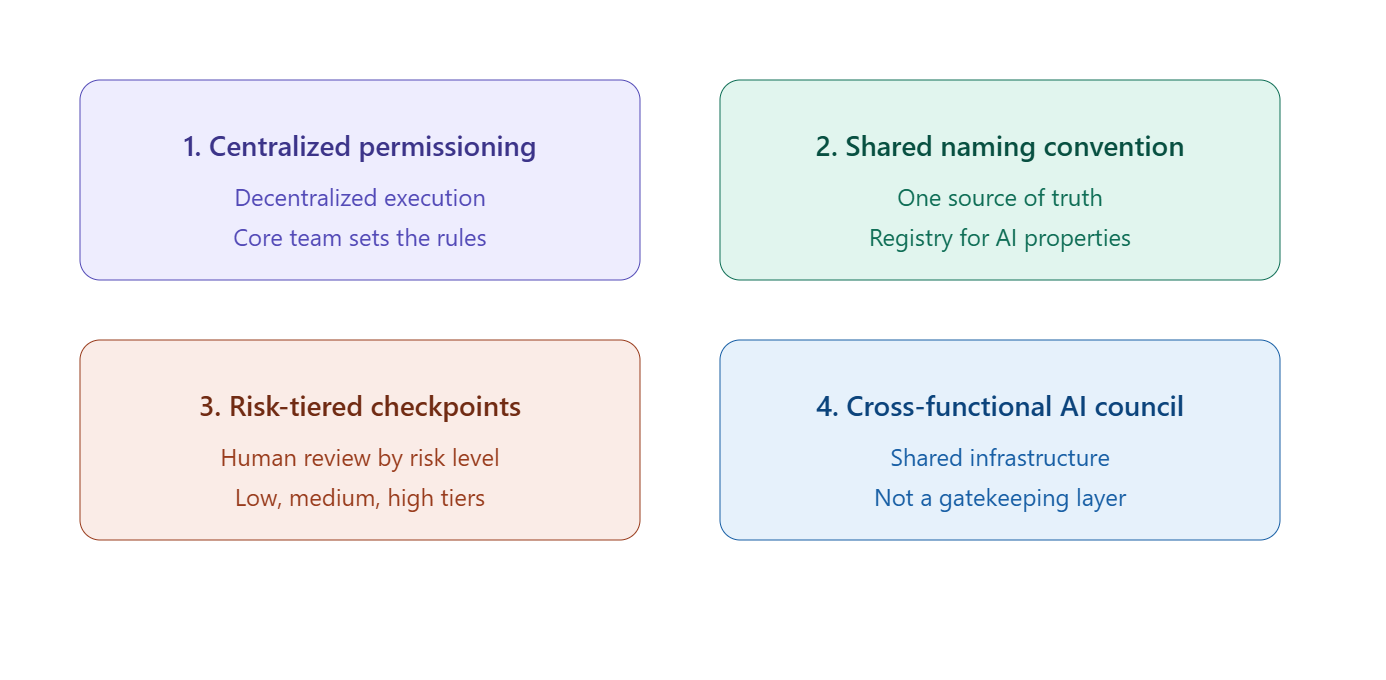
1. Centralized Permissioning, Decentralized Execution
The biggest governance mistake enterprises make is either locking AI features behind a single admin (which kills adoption) or granting broad access to everyone (which creates chaos). The better model:
-
A core RevOps or Systems team owns the permission architecture — which teams can create AI workflows, which can only consume AI-generated insights, and which custom properties are writable by AI tools.
-
Individual teams retain execution ownership — marketing builds its own AI content workflows, sales configures its own AI-assisted sequences — but within guardrails the central team has defined.
Use HubSpot's permission sets and teams structure deliberately here. Don't just mirror your org chart; mirror your data risk — teams touching financial or compliance-sensitive fields need tighter AI write-access than teams working purely on top-of-funnel content.
2. A Shared Property and Workflow Naming Convention
This sounds mundane, but it's often where multi-team rollouts fail first. When five teams independently build AI-powered lead scoring or lifecycle automation, you get overlapping properties like ai_score, lead_score_v2, and ml_priority_flag — none of which anyone trusts anymore.
Before scaling AI adoption, establish:
-
A naming convention prefix for anything AI-generated or AI-modified (e.g.,
ai_prefix on properties,[AI]tag on workflows). -
A single source-of-truth property for shared concepts like lead score or engagement tier, with clear documentation of which AI tool populates it and how often.
-
A retirement process for deprecated AI workflows, so dead automations don't keep firing quietly in the background.
3. Human-in-the-Loop Checkpoints by Risk Tier
Not every AI action carries the same risk. A content-generation suggestion a marketer reviews before publishing is low-risk. An AI workflow that auto-updates deal stage or triggers a customer-facing email is high-risk. Your governance framework should tier these explicitly:
| Risk Tier | Example | Required Checkpoint |
|---|---|---|
| Low | AI drafts a blog outline or email subject line | Optional review |
| Medium | AI scores leads, suggests next-best-action | Weekly spot-check by team lead |
| High | AI auto-sends customer communication, updates deal/revenue fields | Mandatory human approval before go-live; monthly audit |
This tiering prevents both extremes — teams shouldn't need sign-off to brainstorm subject lines, but nobody should be auto-updating ARR-linked fields without a human checking the logic first.
4. A Cross-Functional AI Council (Not a Bottleneck)
Enterprises that get this right don't create a bureaucratic approval chain — they create a small, standing group (often 4–6 people spanning RevOps, Marketing Ops, Sales Ops, and IT/Security) that meets briefly and regularly, not to approve every AI use case, but to:
-
Maintain the shared property/workflow registry
-
Review the high-risk tier audit findings
-
Decide when a team-level AI experiment is ready to become an org-wide standard
-
Retire or consolidate overlapping tools before they multiply
The council's job is to keep velocity high while keeping the data model coherent. If it starts feeling like a gatekeeper that slows teams down, it's structured wrong — its output should be shared infrastructure, not permission slips.
A Practical Rollout Sequence
Trying to govern everything on day one is its own failure mode. A phased approach works better:
-
Audit first. Before adding governance, inventory what AI features are already live across teams, who owns them, and what data they touch. You likely have more shadow AI usage than you think.
-
Establish the registry and naming convention. Get this in place before the next team launches something new — retrofitting naming conventions onto live workflows is painful.
-
Tier existing and new workflows by risk. Apply the checkpoint table above retroactively to what's live, and prospectively to what's planned.
-
Stand up the council with a narrow charter. Start with monthly meetings and a single shared doc; resist the urge to build heavy process before you have real cases to govern.
-
Review and prune quarterly. AI tooling and HubSpot's own AI feature set both move fast. A governance framework that isn't revisited becomes stale within a couple of quarters.
The Payoff
When AI governance is designed well, teams should barely notice it. Sales reps, marketers, customer success teams, and RevOps simply experience AI tools that work consistently, CRM data they can trust, and fewer moments of confusion about why the system took a particular action.
That trust is what determines whether AI adoption succeeds across an enterprise HubSpot portal or gradually loses momentum after inconsistent results and poor user experiences.
At HuboExperts, we believe the goal is not to slow down AI adoption. It is to create the right foundation so AI can scale confidently across teams, regions, and business units.
Because when ten teams use AI inside the same CRM, they should not be running ten disconnected experiments. They should be working within one coordinated, trusted, and scalable revenue system.
Frequently Asked Questions
1. Do we need a formal governance framework if we're only using HubSpot's built-in AI features (Breeze), not custom-built tools?
Yes. Even native features like Breeze Copilot or AI-assisted lead scoring can be configured differently by different teams, write to shared properties, and drift over time. Governance applies to any AI feature that touches shared data, not just custom integrations.
2. How many teams need to be involved before governance becomes necessary?
There's no hard number, but the tipping point is usually when two or more teams are independently configuring AI features that touch the same objects (contacts, deals, tickets). At that point, overlapping properties and conflicting logic become a real risk, not a hypothetical one.
3. Won't a governance framework slow down AI adoption?
Done right, it shouldn't. The framework in this post is designed to centralize permissioning while leaving execution decentralized, so teams still move fast on their own AI workflows — they just do it within shared guardrails instead of building in isolation.
4. Who should own the AI governance council?
Typically RevOps or Marketing Ops, since they usually have the clearest cross-team visibility into the data model. The council itself should stay small (4–6 people) and cross-functional, spanning RevOps, Sales Ops, Marketing Ops, and IT/Security.
5. What counts as a "high-risk" AI workflow?
Anything that acts on a customer-facing channel without human review, or writes to revenue-critical fields — for example, an AI workflow that auto-sends emails or updates deal stage/ARR fields. These need mandatory approval before launch and a recurring audit.
6. How often should the naming convention and property registry be reviewed?
Quarterly is a reasonable default. AI tooling and HubSpot's own AI feature set change quickly, so a registry that isn't revisited becomes stale within a couple of quarters and starts accumulating duplicate or orphaned properties again.
7. What's the first step if we already have AI features live across multiple teams with no governance in place?
Start with an audit, not a policy. Inventory what's already live, who owns each workflow, and what data it touches. You can't design sensible guardrails until you know what you're actually governing — and most enterprises find more shadow AI usage than expected.
8. Does this framework apply only to HubSpot, or does it extend to other tools in the stack?
The framework is written for HubSpot specifically, but the underlying principles — ownership, data scoping, risk-tiered review, a shared council — apply to any system where multiple teams are building AI-powered automation on shared data.
9. How do we prevent the AI council from becoming a bottleneck?
Keep its charter narrow: it maintains the shared registry, reviews high-risk audit findings, and decides when a team-level experiment should become an org-wide standard. It should not need to approve every AI use case — if it starts functioning like a permission gate, it's structured wrong.
10. What's a realistic timeline to get this framework in place?
Most enterprises can complete the audit and registry setup within a few weeks, tier existing workflows within a month, and have the council meeting regularly within a quarter. Trying to implement everything at once is a common failure mode — the phased approach in the post is deliberately sequential for that reason.

