

Revenue operations has always been the discipline of making sales, marketing, and customer success work as one system instead of three departments quietly competing with each other. For the last decade, that meant stitching together CRMs, marketing automation platforms, and a growing pile of point solutions with dashboards, playbooks, and a lot of manual glue holding it all together.
AI agents are now inserting themselves into that glue. They draft outreach, qualify leads, update records, enrich account data, and increasingly hold early-stage conversations with prospects before a human ever gets involved. It's tempting to treat this as a total reset — to assume the RevOps playbook written for the last ten years is obsolete. It isn't. Some parts of RevOps are being rebuilt from the ground up. Other parts matter more than ever, precisely because agents are now acting on the data, rules, and definitions that RevOps owns.
This piece is a practical look at both halves: what genuinely changes when agents join the revenue org, and what stays exactly as important as it always was.
Why This Moment Feels Different
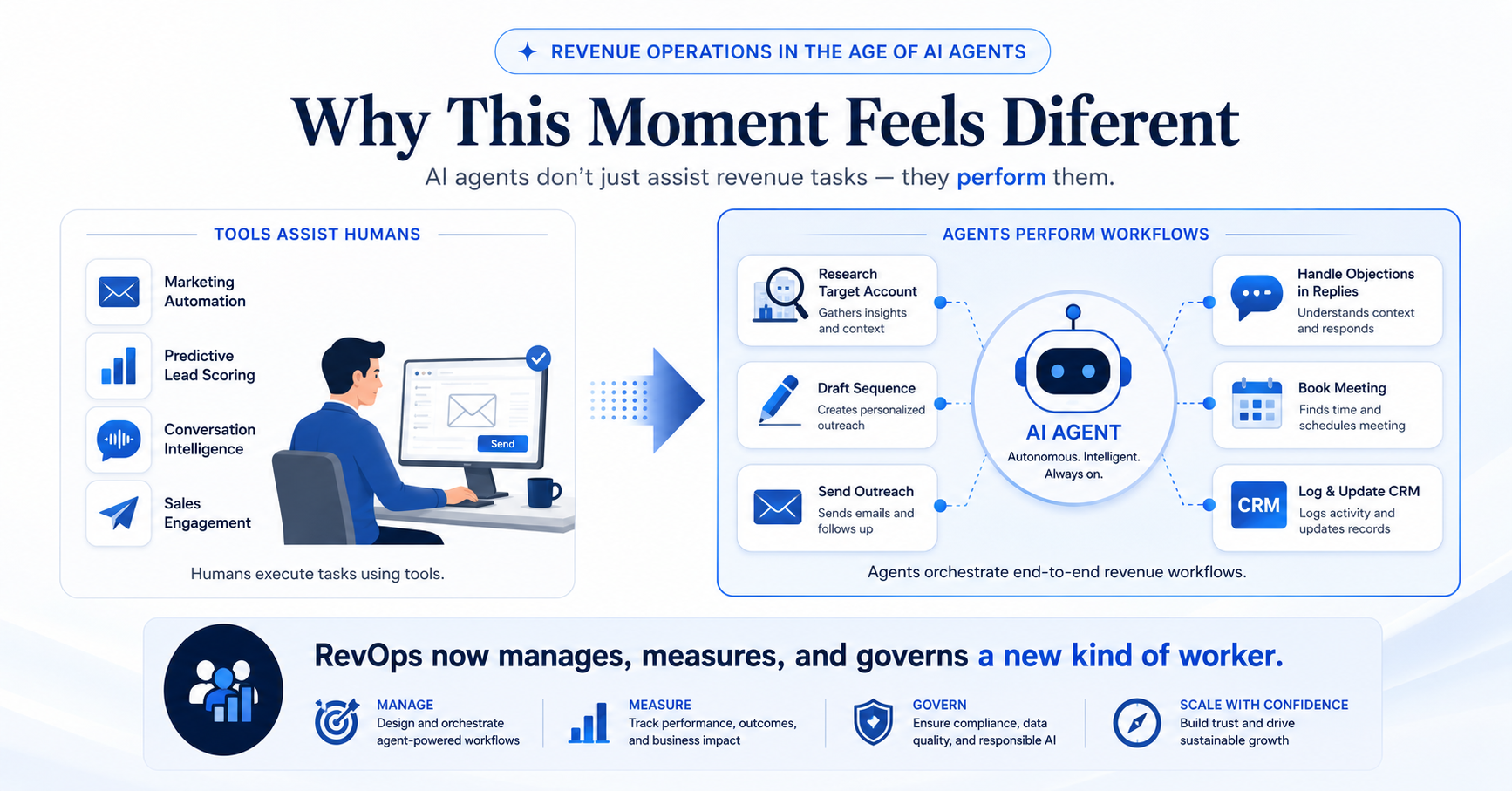
Every few years, RevOps absorbs a new wave of tooling — marketing automation, predictive lead scoring, conversation intelligence, sales engagement platforms. Each wave added a layer of automation on top of human execution. A human still sent the email; the tool just helped them decide when and what to send.
Agents are a different kind of wave because they don't just assist the task, they perform it. An agent can research a target account, draft a sequence, send it, handle objections in a reply, book a meeting, and log every step in the CRM — without a rep touching a single one of those actions. That's not incremental automation. That's a new class of worker showing up in the revenue org, and RevOps is the function best positioned to decide how that worker is managed, measured, and trusted.
That's the frame for everything below: agents are workers now, not just tools. And RevOps has always been the department that designs how work gets divided, measured, and improved. The job hasn't disappeared — it has a new type of teammate to design around.
What Changes
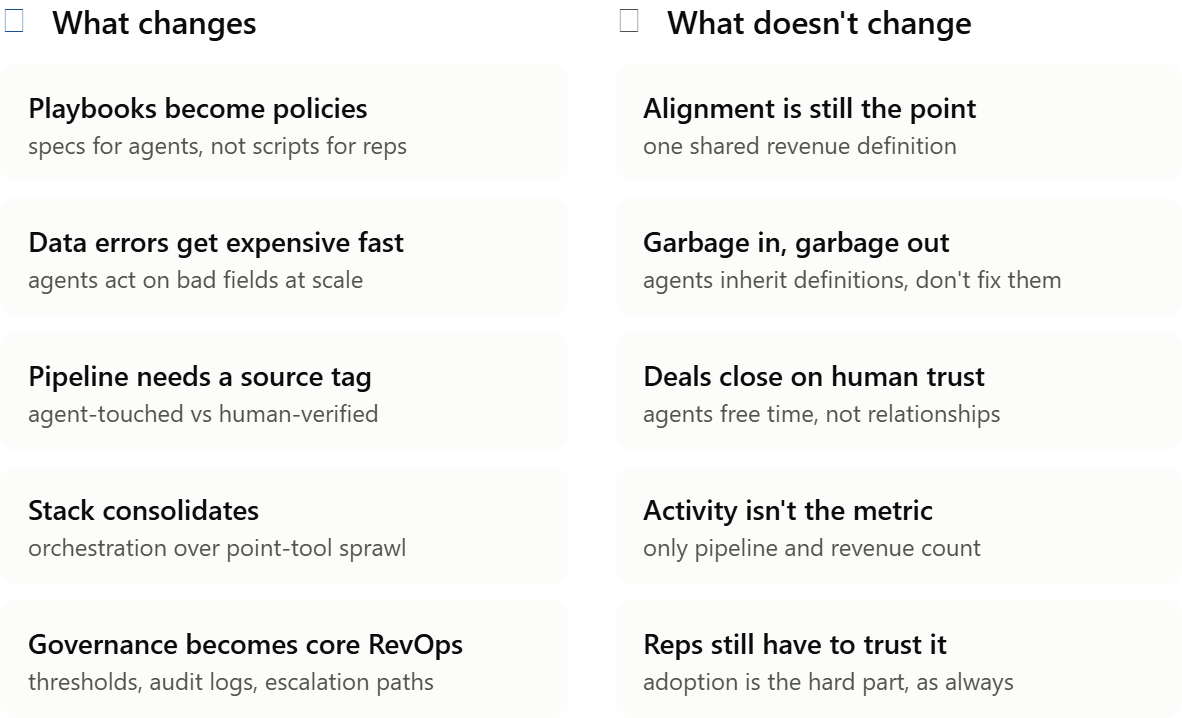
1. The unit of work shifts from "tasks for reps" to "outcomes for agents"
Traditional RevOps design assumed a human executes each step: a rep sends the email, a rep logs the call, a rep updates the deal stage. Playbooks were written as scripts — do this, then this, then this — because they had to be simple enough for a person to follow consistently across hundreds of reps.
Agent-based workflows flip this. RevOps now designs for an agent that can execute a multi-step sequence — research an account, personalize outreach, respond to replies, escalate to a human at the right moment — with far less hand-holding and far more judgment embedded in the system itself.
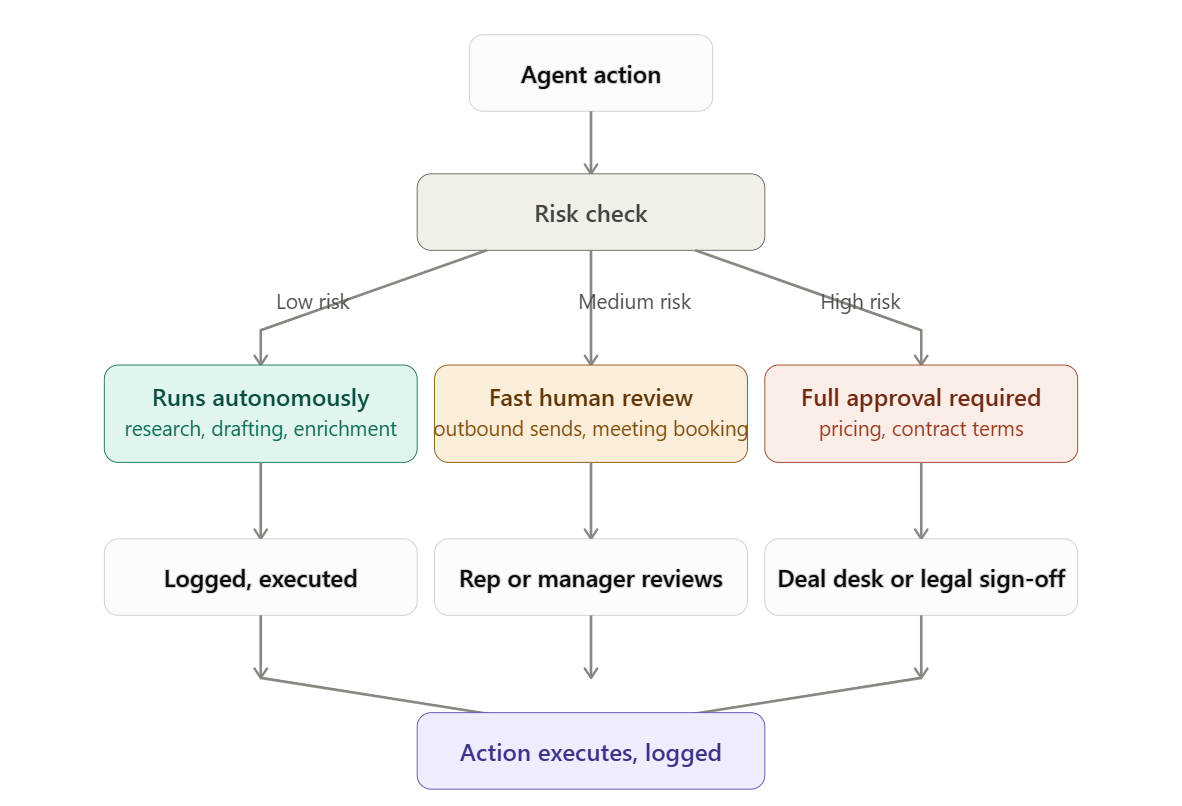
This means playbooks stop being step-by-step scripts for people and start becoming policies for agents: what an agent is allowed to decide on its own, what requires human sign-off, what triggers an escalation, and what "good" looks like at each handoff. Writing a playbook for an agent looks less like a sales script and more like writing a specification — the kind of document an engineer would write to define acceptable behavior for a system, not a motivational one-pager for a sales floor.
Practically, this means RevOps teams are spending more time defining edge cases up front: What does the agent do if a prospect asks about a competitor by name? What if the deal amount falls outside the discount matrix? What if a reply signals urgency or frustration? Those used to be judgment calls reps made in the moment. Now they need to be anticipated and encoded.
2. Data quality goes from "nice to have" to existential
Bad data used to mean a rep wasted ten minutes on a stale lead, or a marketing email went to the wrong segment. Annoying, but contained — a human eventually noticed something looked off and stopped.
Bad data feeding an agent is a different order of problem. An agent doesn't pause to feel like something's off. It confidently emails the wrong contact, misquotes pricing from an outdated field, works a deal that's technically already closed, or reaches out to a customer who explicitly opted out — and it can do all of this at a scale and speed that outpaces any human's ability to notice the pattern before it's caused real damage.
Agents amplify whatever they're given. Clean data compounds into more accurate targeting, better personalization, and faster cycles. Dirty data compounds into brand damage, compliance risk, and wasted spend, at agent speed instead of human speed.
RevOps teams are responding by treating the CRM and data warehouse less like a system of record and more like a system of truth that an agent can act on autonomously. That raises the bar on deduplication, field validation, and real-time syncing far above what was tolerable in a human-only workflow, where a person could often mentally patch over a stale field or a mislabeled stage. Agents can't do that patching — they take the data at face value, so the data has to actually be trustworthy, not just directionally correct.
3. Forecasting and pipeline math need new inputs
Agents generate activity — outreach sent, meetings booked, objections logged, follow-ups scheduled — at a volume and pace no human team could match. That's potentially a gift for forecasting models: more signal, faster, at lower cost.
But it's only a gift if RevOps redesigns how it weighs agent-generated signals versus human-verified ones. An agent-qualified lead isn't automatically as reliable as one a senior AE hand-vetted through a real conversation, and pipeline models that don't distinguish between the two will drift — often quietly, and often in the direction of overconfidence, since agent activity tends to look busy and productive even when it isn't converting.
This is pushing RevOps teams toward more granular pipeline stages that explicitly tag who or what advanced a deal, and toward forecasting models that treat "agent-touched" and "human-verified" as genuinely different categories of evidence rather than collapsing them into a single activity score.
4. The tooling stack consolidates around orchestration
For years, the RevOps tool stack sprawled outward — a point solution for enrichment, another for sequencing, another for intent data, another for conversation intelligence, each with its own login and its own partial view of the buyer. RevOps' job was largely integration: making all these disconnected tools talk to each other well enough that data didn't rot in silos.
The emerging pattern with agents is different: a smaller number of platforms that can orchestrate agents across the funnel — routing tasks, enforcing policy, and logging every action for review — rather than a sprawl of single-purpose tools each doing one narrow job. RevOps' tool-selection criteria are shifting accordingly, from "does it have the feature we need" to "can it be safely and observably delegated to an agent, and can we see and audit everything it does."
This also changes vendor evaluation. A tool that's excellent at one task but opaque about how it makes decisions is now a bigger liability than it used to be, because RevOps needs to be able to explain — to sales leadership, to legal, to the customer if it ever comes to that — why an agent did what it did.
5. Governance becomes a core RevOps function, not a compliance afterthought
When an agent can send an email, update a contract term, or apply a discount without a human in the loop, someone has to own the rules of engagement: what agents are allowed to say, who they're allowed to contact, how mistakes get caught, and how they get corrected before they repeat.
This used to live loosely across sales enablement, legal, and IT, often addressed reactively after something went wrong. Increasingly, it's becoming RevOps' job to define and enforce this proactively, because RevOps is the function that already owns the systems agents plug into and the data agents act on. RevOps is uniquely positioned to see across the whole funnel, which is exactly the vantage point needed to govern something that operates across the whole funnel too.
In practice, this looks like RevOps building approval thresholds (deal size, discount percentage, contract terms) that automatically route to a human; audit logs that make every agent action reviewable after the fact; and clear escalation paths so agents know when they're out of their depth. This is new organizational territory for most RevOps teams, and it's one of the fastest-growing parts of the job.
What Doesn't Change
1. Alignment is still the whole point
RevOps exists to stop sales, marketing, and customer success from optimizing against each other — marketing chasing volume while sales wants quality, sales closing deals customer success can't renew, each team measuring success by a different number. Agents don't remove that tension. They can make it worse if each team deploys its own agents, pointed at its own goals, with no shared definition of what a good outcome actually looks like.
The core RevOps job — getting everyone to row toward the same revenue definition — is unchanged. If anything, it's more urgent now, because misaligned agents can create damage faster and at greater scale than misaligned humans ever could. A marketing agent over-qualifying leads to hit a volume target and a sales agent burning through them to hit an activity target is the AI-era version of the same old marketing-sales conflict, just running at machine speed.
2. Garbage in, garbage out
This is the oldest rule in operations, and AI hasn't repealed it. An agent trained or prompted on a flawed lead-scoring model will just execute the flaw faster and at greater scale than a human ever could. The discipline of defining what a qualified lead actually is, what a healthy deal stage looks like, and what "customer health" really means still has to be done by humans who understand the business — agents don't invent those definitions, they inherit them.
If anything, agents make sloppy definitions more visible and more costly, because there's no human intuition quietly compensating for a fuzzy rule in the moment. The rule gets applied exactly as written, every time, at scale.
3. Trust is still earned deal by deal
Buyers still buy from people they trust, especially for complex or high-stakes purchases. Agents can accelerate research, follow-up, and administrative work, dramatically reducing the friction and delay around a deal. But the relationship-building moments that actually move six- and seven-figure deals forward — the moments where a buyer needs to feel understood, reassured, or genuinely heard — are still fundamentally human.
RevOps' long-standing job of freeing up reps' time so they can spend it on those moments hasn't changed. It's just gained a far more powerful tool for doing it. The goal was never to automate the relationship away; it was always to automate everything around the relationship so the relationship gets more attention, not less.
4. Metrics only matter if they tie to revenue
There's a real temptation to start measuring "agent efficiency" metrics — emails sent, tasks automated, response time, hours saved — as ends in themselves. That's the same trap RevOps teams fell into with marketing automation a decade ago: activity metrics that look impressive on a dashboard but don't map to pipeline or closed revenue.
The discipline of tracing every metric back to an actual revenue outcome is unchanged, and arguably more important now, because it's easier than ever to generate a lot of impressive-looking agent activity that doesn't actually convert. A RevOps team that starts celebrating "10,000 agent-sent emails this month" without asking how many of those became qualified pipeline is repeating a mistake the function already learned to avoid once.
5. Change management is still the hard part
The technical work of deploying an agent is often the easy part — connect it to the CRM, give it a playbook, turn it on. Getting sales leaders to actually trust an agent's lead scoring, getting reps to use agent-drafted outreach instead of quietly ignoring it and writing their own, getting customer success to act on an agent-flagged churn risk instead of dismissing it — that's the same change management problem RevOps has always faced with new tools, just with higher stakes because the "tool" is now doing more of the actual work.
Adoption, training, incentive design, and executive sponsorship still determine whether a good system actually gets used. A brilliant agent that reps don't trust and quietly route around is worth exactly nothing, and no amount of AI capability fixes a trust problem — only the same change management fundamentals RevOps has always relied on can do that.
The Practical Shift
At HuboExperts, we believe the right question is not, “How do we add AI agents to RevOps?” The better question is, “Which parts of the revenue process can be safely owned by AI, and which still require human trust, judgment, and accountability?”
That distinction matters. AI agents are well suited to policy-driven and data-driven work such as research, lead qualification, routing, follow-ups, CRM updates, and reporting. Human teams are still essential when the work involves relationship-building, negotiation, strategic decisions, or complex customer situations.
The biggest risk is not moving too slowly. It is deploying AI agents on top of messy data, unclear lifecycle stages, inconsistent processes, and misaligned teams. Automation cannot fix a weak RevOps foundation. It simply executes that weakness faster and at a larger scale.
Before introducing agents, businesses need clean CRM data, clear definitions, reliable workflows, agreed ownership rules, and alignment across sales, marketing, and customer success. These have always been the foundations of effective RevOps, but AI makes them even more important.
AI agents are not replacing RevOps. They are giving RevOps teams a more powerful workforce to design, manage, and measure. The organizations that benefit most will be those that combine automation with strong governance, data discipline, human oversight, and cross-functional alignment.
At HuboExperts, we help businesses build that foundation first, so AI agents improve the revenue process instead of adding more complexity to it.
Frequently Asked Questions
1. Are AI agents going to replace RevOps teams?
No. At HuboExperts, we see AI agents as an extension of RevOps, not a replacement. They automate research, follow-ups, CRM updates, and reporting, while RevOps teams continue to manage data quality, lead definitions, alignment, governance, and strategy. AI changes how RevOps works, but makes the function even more important.
2. What's the biggest risk of deploying AI agents in revenue processes?
Bad data. Agents act on whatever they're given without the intuitive pause a human might apply to a field that looks off. Poor data quality that used to cause minor, contained mistakes can now cause fast, large-scale ones — wrong contacts, incorrect pricing, or outreach to opted-out customers, all happening at machine speed before anyone notices.
3. Do agent-generated leads count the same as human-qualified leads in a forecast?
They shouldn't be treated identically. Agent-touched and human-verified leads carry different levels of reliability, and forecasting models that collapse them into one activity score risk drifting toward overconfidence. Most teams are moving toward pipeline stages that explicitly tag how a deal was advanced.
4. How should a RevOps team start governing AI agents?
Start with clear boundaries: what dollar amounts, discount levels, or contract terms require human approval; what topics or situations trigger an automatic escalation; and an audit log that makes every agent action reviewable after the fact. Governance doesn't need to be perfect on day one, but it does need to exist before agents are given real autonomy.
5. Will AI agents reduce the size of sales and marketing teams?
It varies by organization, but the more consistent shift is in what people spend time on rather than simply headcount. Agents tend to absorb research, drafting, follow-up, and data entry, freeing reps to spend more time on relationship-building and complex negotiation — the parts of a deal that still require human judgment and trust.
6. What happens to sales playbooks in an agent-driven workflow?
They evolve from step-by-step scripts written for people into policy documents written for systems — defining what an agent can decide autonomously, what needs human sign-off, and how edge cases should be handled. This requires anticipating scenarios in advance rather than trusting a rep's in-the-moment judgment.
7. How do you measure whether an AI agent is actually working?
The same way you'd measure any RevOps initiative: by its effect on revenue, not by activity volume. High email-send counts or fast response times mean little if they aren't converting into qualified pipeline and closed revenue. Tie every agent metric back to a revenue outcome, not just an efficiency number.
8. Can AI agents handle the entire sales cycle without human involvement?
Not for complex or high-value deals. Agents are well suited to research, qualification, outreach, and administrative work. But trust-building for larger or more complex purchases still tends to require a human presence, especially at the negotiation and closing stages.
9. What's the first thing a RevOps team should fix before deploying agents?
Data quality and clear definitions. Agents inherit whatever rules and data they're given — they don't fix fuzzy lead-scoring criteria or messy CRM records on their own. Cleaning up the data and tightening the definitions of qualified lead, deal stage, and customer health should come before scaling up agent autonomy.
10. How is tool selection changing because of agents?
The evaluation criteria are shifting from feature richness toward safety and observability. RevOps teams increasingly favor a smaller number of orchestration-capable platforms that let them see, audit, and control what an agent does, over a sprawl of point solutions that each handle one task well but offer little visibility into agent decision-making.

