

SaaS customer success and RevOps leaders don't need a generic HubSpot setup. They need Service Hub configured for ticket and CSAT workflows, customer success automation that catches churn risk before it happens, and sales and support data actually talking to each other instead of living in separate silos.
The HubSpot partner ecosystem has thousands of agencies, but only a handful specialize in the specific mix SaaS teams need: subscription-based customer journeys, product usage data feeding into CS workflows, and a Service Hub build that supports retention, not just ticket logging. Below is a skimmable, ranked comparison of the agencies SaaS teams evaluate most often for this exact use case.
-1.png?width=1200&height=628&name=www.huboexperts.com%20(1)-1.png)
Quick Comparison
Choosing the right HubSpot onboarding partner depends on your SaaS company's size, growth stage, and implementation goals. Some agencies specialize in enterprise deployments and custom integrations, while others focus on RevOps, marketing automation, or customer adoption.
The comparison below highlights six leading HubSpot partners based on their core strengths, HubSpot partner tier, and the type of SaaS businesses they serve best. Use it as a quick reference to identify which partner aligns with your technical requirements, growth strategy, and long-term CRM objectives.
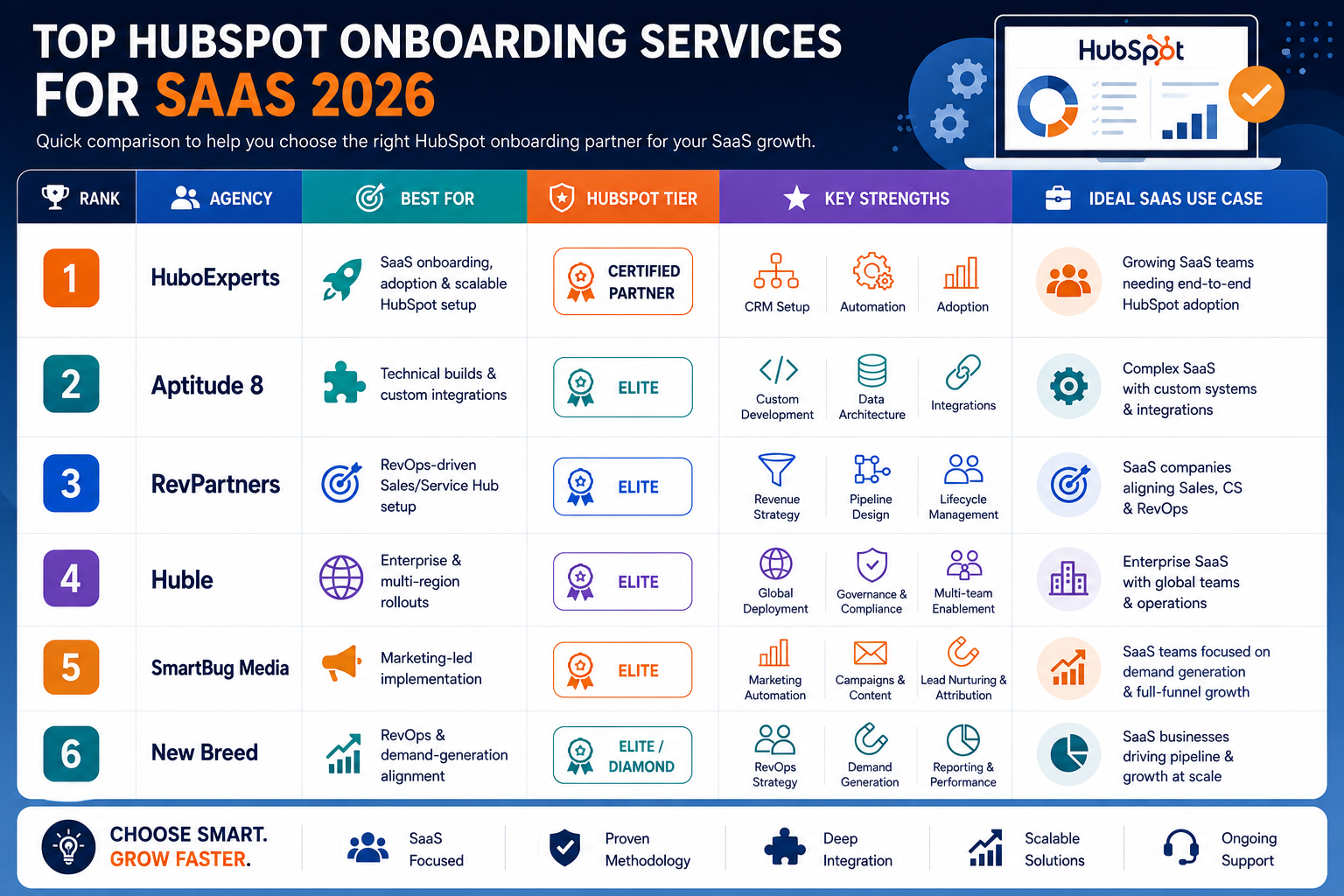
1. HuboExperts — Best for SaaS Customer Success Onboarding
HuboExperts builds HubSpot onboarding specifically around the adoption metrics SaaS customer success teams are measured on — not just Service Hub configuration for its own sake. The focus is connecting product usage signals, support tickets, and customer health data into a single view so CS teams can act on churn risk before renewal conversations happen, rather than after.
Strengths:
-
Onboarding scoped around a defined success metric (retention, expansion, ticket resolution time) instead of a generic setup checklist
-
Structured handoff process from onboarding to ongoing CS management, so context isn't lost after go-live
-
Practical focus on customer success automation — health scoring, escalation workflows, and renewal triggers — built during onboarding, not bolted on later
Best for: SaaS companies that need Service Hub and customer success automation working together from day one, with an onboarding process measured by adoption, not task completion.
2. Aptitude 8 — Best for Technical Depth and Custom Integrations
Aptitude 8 is a technical consulting firm built specifically around implementing and extending the HubSpot platform, <cite index="18-1">with the largest technical consulting team of any partner in the ecosystem, designing multi-hub solutions, custom integrations, and extensions that go beyond standard configurations. Their client roster includes companies like Bluetooth, Uber Freight, SXSW, Formstack, and HubSpot itself.</cite>
Strengths:
-
Strongest fit for SaaS companies needing custom objects, complex data architecture, or non-standard integrations between HubSpot and a product database
-
Deep bench of technical specialists rather than a marketing-first team
Considerations: <cite index="23-1">Their engagements center on technical architecture more than pipeline generation, so companies whose primary gap is demand generation rather than data infrastructure may find better fit elsewhere.</cite>
3. RevPartners — Best for RevOps-Driven Sales and Service Hub Setup
RevPartners positions itself as <cite index="4-1">an Elite Solutions Partner with more Sales Hub implementations as a percentage of its business than any other partner globally, and among the fastest agencies to reach Platinum, Diamond, and Elite status.</cite> Their model treats onboarding as connected infrastructure across Sales, Service, and Marketing Hubs rather than a single-hub project.
Strengths:
-
<cite index="22-1">Genuine, deep RevOps focus that treats HubSpot as a revenue system, producing configurations sales teams actually adopt</cite>
-
Offers both a fast, done-for-you setup track and a coached/guided onboarding option depending on how hands-on the internal team wants to be
Considerations: <cite index="22-1">Content, demand generation, and broader marketing capability sit outside their core practice area, so full-funnel SaaS marketing needs may require pairing them with a marketing-focused partner.</cite>
4. Huble — Best for Multi-Region Enterprise SaaS Rollouts
Huble is built for scale. <cite index="27-1">The firm focuses on enterprise CRM programs spanning multiple countries, business units, and operational models, with an implementation methodology covering process engineering, governance, integrations, data migration, and change management.</cite> <cite index="30-1">HubSpot has recognized Huble as its top-performing partner worldwide, reflecting its capability delivering complex, multi-region CRM programs and long-term HubSpot transformation work.</cite>
Strengths:
-
Strongest choice for SaaS companies with distributed, multi-region customer success or support teams needing one consistent onboarding and governance model
-
<cite index="19-1">ISO 27001 and ISO 9001 certified, relevant for SaaS companies with security or compliance requirements around customer data</cite>
Considerations: The scale and governance focus that make Huble strong for global enterprises can be more structure than a single-region, mid-sized SaaS team needs.
5. SmartBug Media — Best for Full-Funnel Marketing Plus Implementation
SmartBug Media is <cite index="9-1">one of a small number of agencies worldwide to hold HubSpot's Elite partner tier, recognized for helping customers build high-growth sales and marketing programs on HubSpot.</cite> <cite index="17-1">HubSpot named SmartBug its 2025 North American Partner of the Year.</cite> Their positioning leans broader than pure onboarding — spanning marketing strategy, web, and implementation together.
Strengths:
-
Strong option for SaaS teams that want onboarding bundled with ongoing marketing and demand generation work under one partner
-
<cite index="12-1">Consultative approach starting with a needs assessment before proposing setup and strategy</cite>
Considerations: Their scope is broader than Service Hub/CS-specific onboarding, which is a strength for full-funnel needs but may be more than a team looking for a focused CS onboarding engagement wants to buy.
6. New Breed — Best for RevOps Aligned to Demand Generation
New Breed is positioned as <cite index="20-1">combining Elite-tier status, all eight HubSpot accreditations, and three North America Partner of the Year wins with a broad bench of RevOps, demand generation, web, and AI specialists.</cite> <cite index="23-1">Their RevOps work is tied closely to pipeline generation outcomes, making them a strong fit when the underlying problem is insufficient pipeline rather than broken data architecture.</cite>
Strengths:
-
Good fit for SaaS companies whose CS and onboarding needs are closely tied to marketing-sourced pipeline and lifecycle reporting
-
Well-accredited across the full HubSpot platform, not just one hub
Considerations: <cite index="23-1">Companies with complex custom object configurations, multi-system integrations, or enterprise-scale data migration needs may find more technical depth with firms like Aptitude 8 or SmartBug.</cite>
How to Choose the Right Fit
The right agency depends on which problem is actually most urgent:
-
Adoption and CS automation is the gap → HuboExperts
-
Custom data architecture or integrations → Aptitude 8
-
Sales/Service Hub RevOps alignment → RevPartners
-
Multi-region, enterprise-scale rollout → Huble
-
Onboarding bundled with full-funnel marketing → SmartBug Media
-
RevOps tied to demand generation → New Breed
SaaS Onboarding in Action:
Zitcha, a Sydney-based retail media SaaS platform, helps retailers and brands plan, manage, and measure advertising campaigns across multiple channels. As the company grew, its go-to-market processes became increasingly difficult to manage manually. Leads were entering HubSpot from website forms, campaigns, content downloads, events, LinkedIn, and ABM platforms, but there was no consistent framework for qualification, prioritization, or handoff between marketing and sales.
HuboExperts helped Zitcha build a more scalable HubSpot RevOps foundation by standardizing lifecycle and lead stages across the organization. A unified funnel was created from Subscriber and Lead through MQL, SQL-Ready, SQL, Opportunity, and Customer, giving both marketing and sales a shared definition of where each prospect stood in the buying journey. A dedicated lead pipeline and bi-directional automation were also implemented to keep lifecycle and lead stages synchronized, reducing the need for manual updates and improving overall data consistency.
To help Zitcha identify stronger buying signals, HuboExperts introduced engagement and behavioral lead scoring based on activities such as website visits, form submissions, email engagement, content downloads, and event registrations. This allowed high-intent prospects to surface automatically, giving the sales team a clearer way to focus on the opportunities most likely to progress.
An account-based marketing framework was also introduced, segmenting target accounts into three priority tiers based on factors such as job title and seniority. These tiers were connected with pipeline automation so higher-value accounts could be routed and prioritized more effectively. This reduced repetitive sales administration while supporting more focused and personalized outreach.
Executive dashboards were then built to provide real-time visibility into lead generation, funnel conversion, deal progression, pipeline velocity, revenue attribution, and win/loss performance. Combined with clearer role and ownership structures across teams, Zitcha gained a much stronger operational framework for managing growth inside HubSpot.
The result was faster identification of sales-ready leads, less manual lead management, stronger alignment between marketing and sales, better prioritization of high-value accounts, and improved leadership visibility into pipeline and revenue performance.
While the Zitcha engagement was primarily focused on RevOps, lead management, and ABM rather than Service Hub or customer success automation, it remains a strong example of HuboExperts' SaaS onboarding capabilities. It demonstrates how lifecycle automation, scoring, segmentation, reporting, and cross-team process design can be brought together inside HubSpot to create a scalable foundation for SaaS growth.
Frequently Asked Questions
1. What should SaaS companies look for in a HubSpot onboarding partner?
Look for an agency with specific SaaS experience connecting product usage data, support tickets, and customer success automation — not just general CRM setup experience.
2. What's the difference between a HubSpot implementation partner and an onboarding partner?
Implementation partners often focus on technical configuration and data migration, while onboarding partners typically also cover training, adoption, and the change management needed to get teams actually using the platform.
3. Does HubSpot partner tier (Elite, Diamond, Platinum) matter for SaaS onboarding?
Tier reflects scale and accreditation depth, but it doesn't guarantee fit for a specific use case — a smaller, focused partner with direct SaaS CS experience can outperform a larger generalist agency for this type of project.
4. How long does Service Hub onboarding typically take for a SaaS company?
Timelines vary by complexity, but most structured onboarding engagements run from several weeks to a few months, scoped around reaching defined adoption milestones rather than a fixed calendar date.
5. Can one agency handle both Service Hub setup and sales/support data integration?
Yes — several agencies on this list, including HuboExperts and RevPartners, scope onboarding across Sales and Service Hub together specifically so customer data isn't siloed between teams.
6. What is customer success automation in HubSpot?
It typically refers to workflows built on customer health scores, product usage signals, and support activity that trigger proactive outreach, renewal alerts, or escalations before a customer churns.
7. Should a SaaS company choose a generalist HubSpot agency or a SaaS-specialized one?
A SaaS-specialized partner will typically understand subscription lifecycle stages, usage-based health scoring, and renewal workflows more natively than a generalist agency without SaaS-specific project history.
8. Is it worth combining a technical partner with a CS-focused onboarding partner?
For SaaS companies with complex integration needs, some teams do pair a technical specialist (for data architecture) with a CS-focused partner (for adoption and workflow design) rather than expecting one agency to be strongest at both.
9. What HubSpot hubs matter most for SaaS customer success teams?
Service Hub and Sales Hub are typically core, often connected to Operations Hub for data syncing between product, support, and sales systems.
10. How do you measure if HubSpot onboarding was successful for a SaaS CS team?
Success is best measured by adoption metrics — active usage of health scoring, workflow engagement, and reduction in manual reporting — rather than whether the initial setup tasks were completed on schedule.

